Almost a year ago Valve announced their second stab at a “Steam Machine” — a custom console designed around linux, that could play (most of) your steam library.
The first one (in 2015) didn’t go well for a few reasons:
- It ran Linux, but there was WAY less Linux support for games — you could only play a fraction of your games on the device
- There wasn’t a unique reason to buy a steam machine — you could just buy a windows box and play all your games
- The new controller was too different
- They relied on a partner system which created a fractured user experience
(for what it’s worth, I liked the controller, which you can see here:
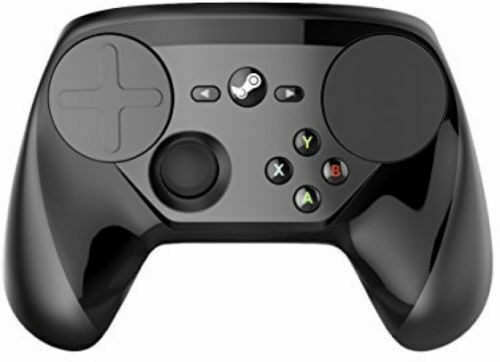
however I understand why it was a hard sell for a lot of people, and if I’m being honest I didn’t end up using it much)
Instead of giving up they spent the next decade fixing most of those problems:
- They built Proton, a translation layer that allows most windows games to run on Linux (some of them run better on Linux than on Windows, even on the same hardware)
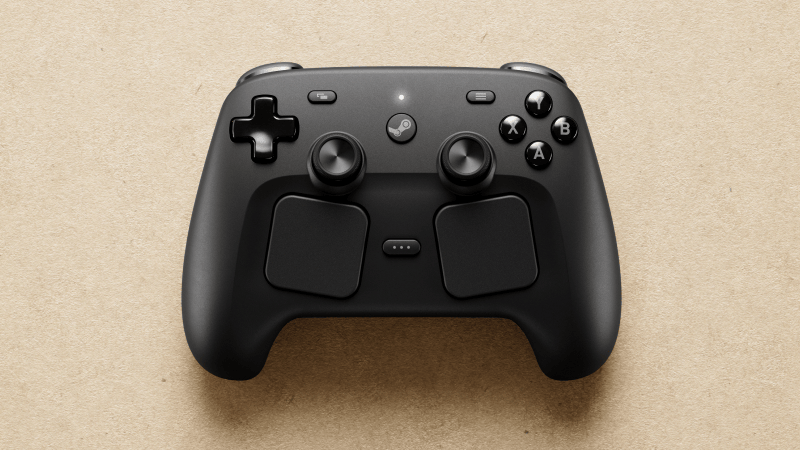
- They made a second gen steam controller which looks a lot more like what we’re used to (though they maintained their love of giant touch pads)
But what about those other two problems? A lack of differentiation and a unique value proposition? And what about the janky partner setup? How did they solve these for the Steam Machine?
Well, they didn’t. They built something different first:
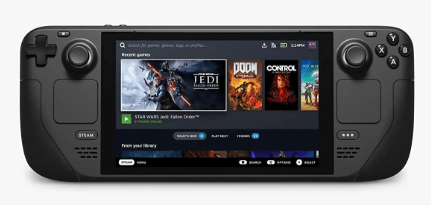
The Steam Deck, not the Steam Machine (gen two), actually solved all the problems with the first steam machines. It played most of your library, and it offered a unique and compelling reason to buy one — you could bring your library on the go, and for relatively cheap, to boot. Plus Valve made it themselves — they didn’t rely on third parties.
And it was a pretty massive success, not just in terms of sales (I’m not sure how many Valve sold compared to their hopes), but in changing gaming landscape. Even more than the switch, it pushed “real” console companies to produce handhelds, to the point that both Sony and Microsoft have indicated that their next console generation will include handhelds.
That’s crazy! I mean, they saw the Switch, but they didn’t decide to make any changes until Valve showed them more than just the casuals wanted a portable.
So what about that steam machine??
Right, right, I was reviewing the steam machine, not the steam deck.
But that is how we got here, and what’s interesting is the steam machine still doesn’t solve one of the problems the steam deck does. I mean, it is Valve Made, sidestepping any partners, but there’s still the issue of the unique value proposition.
Does the Steam Machine (gen 2) have a unique value proposition? Is there a compelling reason for you to buy it? Well … yes and no. It depends pretty highly on your circumstances, so I thought I’d just point out the scenarios where it probably makes the most sense:
Scenario 1: You’ve got a steam library and you want to play on the TV, like a console
The steam machine is literally perfect for you. If you already buy games on Steam, you don’t have another console, and you want to play on the TV the Steam Machine is the best way to do that.
The steam machine does have some quirks that are annoying (or great, depending on your point of view, more on that later), but it’s still better than just hooking a PC up to your TV.
But it’s not as polished as a console like the PS5, either. For example, I set up the Steam Machine downstairs where I could plug into the internet and download a bunch of games. Downstairs I have a surround sound system.
Then I plugged it in upstairs where we don’t have surround sound and all of a sudden voices in cut scenes were super quiet, if they played at all. In fact, everything with audio was a little weird and echoey.
I figured out that I had set it up for 7.1 surround, which feeds voices out the center channel, but because upstairs didn’t have a center channel the audio just didn’t go anywhere. Great, just open up audio settings and … yeah, there’s no way to fix it. In audio settings you can choose an output, but not change the format.
I was worried I’d have to re-image the machine, but then I remembered that there’s a full Linux desktop, so I booted into that, found the audio controls, changed it to Stereo instead of Surround, went back into steam and BOOM, problem solved!
But I knew how to do all that. Would most people? Would your average console player? Probably not.
This is why it’s great for a first console of a PC gamer (who is used to having to tweak things occasionally), but isn’t great for someone switching from a PS5 or XBOX.
Scenario 2: You like to tinker
As mentioned above, you going to need to tinker with a Steam Machine occasionally, so it helps if you like to do that (I’m one of those weirdos).
But the fact that the steam machine is a full Linux PC opens all kind of doors. One of the most obvious is that it makes it easier to reuse the Steam Machine for something other than just a console.
You could stick it on your desk and make it a pretty powerful small-form-factor PC, if you want. You could stick it in the basement and run a server off it (even some local LLMs if you’re into that). You could do anything with it that you want.
This is a huge difference from a regular console. When I set up the Steam Machine I pulled an XBOX off the shelf and set it on the ground. I didn’t play the XBOX regularly, but I did occasionally for a console exclusive or something. Now, the XBOX series X is almost twice as tall as the Steam Machine, but otherwise it’s pretty similar. In fact, although it’s several years old, it is still a little more powerful (12 TFLOPS vs 9 TFLOPS — if you aren’t familiar with teraflops we can just say the Xbox Series X is roughly 20% more powerful) than the steam machine, AND cheaper (about $800 vs the ~$1200 for the steam machine).
BUT, you can only use it for one thing. Playing XBOX games. I saw it sitting there on the floor and I thought to myself “What a waste.” Imagine what I could do with the hardware if I could actually do whatever I wanted with it! But you can’t. Maybe you can jailbreak it and void the warranty, but those solutions are always super hacky anyway.
But the steam box I can! If there’s something I want to try, or something else I want to do with it, or if I upgrade and now I want to just have it be a computer for the kids or something? I could do all that! The XBOX is either an XBOX or a paperweight. That kind of sucks.
Scenario 3: You consider the moral implications of your console purchases very carefully
Valve is, for the most part, held in higher regard when it comes to things like “being a good company who tries to make the right choice” than companies like Microsoft or Sony. That shows with the Steam Machine — even in something as simple as “it’s your hardware and you can do what you want with it” like we mentioned above.
This difference is even more stark when compared with a company like Meta. In Gamers Nexus’s review of the steam frame (the next hardware coming out from valve) they had a section comparing the privacy policies of Valve vs those of Meta (who have their own Occulus quest). The whole section is worth a watch, but what they highlight is that Meta outlines some of the stuff they gather about children who use their product such as:
- Dimensions of the room they play in
- Their connections to friends
- Games they play
- Audio recordings
- Video recordings
- Physical data included
- Hand and body data
- Gaze data
- Facial expression data
- Fit data
This data is all added to the vast amount of information they have about you already and used to target advertisements at you and your children and their friends and everyone else on earth.
Valve has you sign two user agreements, and they clarified that they don’t collect any of the above data — all of that happens on the device and stays there — except in the event that you need support, in which case you can choose to include logs of data related to your support request, but it isn’t included automatically.
The difference is night and day.
Now, Valve vs Meta is almost like stacking the deck, but I would guess that on the continuum of privacy policies Microsoft and Sony are closer to Meta than they are Valve.
In general, I would argue that Valve is a company that respect consumers and partners more than most (though they’re not perfect). So if you care about things like that, and if you care about eWaste and what happens to your console when the new one comes out, I would say Valve is a better choice for you.
Is that it?
Honestly? Those are the big ones I could think of.
We’ve already determined that the Steam Machine isn’t a big graphics upgrade over the existing consoles. It still requires a little more fiddling than the existing consoles as well. And it’s still more expensive than existing consoles. More expensive, less capable, more finicky isn’t a great sales pitch.
But if you fall into one (or more) of those three groups, I would still recommend. I fall into two of them and I consider it a pretty solid buy.

