Recently, Clay made waves when they released an “AI Writing Policy.” This policy has a few core tenets, among which are:
- You must stand behind every idea and sentence
- Writing is thinking
- More time should be spent writing a document than consuming it
- Longer is not better
These are solid pieces of advice. For like … a freshman in high school.
I’m reminded of a fantastic video by Patrick Boyle called “Tech Bros Inventing Things That Already Exist.” The whole video is worth a watch for his dry humor, but I especially love “Bodega” — an AI-powered (of course) box where you insert money and it dispenses a variety of items. One might describe this a machine for vending said items.
In this case, a tech company has reinvented Strunk & White for the AI age, in the form of a corporate memo that reinvents “Vigorous writing is concise” as “Longer is not better” which, I hate to point this out, could be shortened to “Shorter is better.”
(I didn’t hate pointing that out, I chuckled as I wrote it)
As fun as it is to dunk on people, though, this isn’t the first time someone has had to publicize seemingly obvious advice because people were using a new tool wrong — and it won’t be the last.
History doesn’t repeat but it does rhyme
Blockchain technology is really interesting. The idea that you could create a distributed, public ledger that is impossible to tamper with once written has some amazing potential applications.
But you forgot blockchain was a distributed ledger, didn’t you? As soon as you read “Blockchain” you probably thought about a few things. Bitcoin, first of all. Then NFTs probably came to mind. Maybe Ether. Bored Apes. Some kind of … mobile game with blockchain eggs or something made by a Youtuber?
Some of these were useful applications of blockchain. Some of them were big ol’ wastes of time. Often blockchain was deployed in a way that created new problems, which created the need for new solutions, which could just be avoided by using some other technology (who remembers blockchain for inventory management? Why not just use a regular database? Because nobody gets excited about SQL!)
Humanity, and especially tech people, love something new. And when they are in the throes of techstasy (technology ecstasy) they assume the new tool can solve every problem they’ve ever had — even problems they’ve already solved.
Blockchain is a great example, but there are hundreds more — just watch the Patrick Boyle video above and realize that all of these “innovations” are examples of the same thing. Someone using a hot new technology to solve an old problem. They got excited about apps, bluetooth connectivity, machine learning, or just Apple’s general aesthetic, and went to town.
My favorite example, which I’ve used before, is PowerPoint. PowerPoint has its uses, but enthusiastic users (or less enthusiastic people asked to use it by their managers) have made it so a powerpoint ends up in almost every meeting, every lecture, every class. It’s omnipresent, and it sucks. I feel a tremor in the force, like a thousand meeting attendees letting out a groan all at once, every time I bring it up.
But, PowerPoint doesn’t suck in and of itself. It’s just a tool. PowerPoint sucks as much as a hammer does. What makes it suck is how it’s used.
And, like any tool, some people use it better than others. So if you require everyone to use a tool, and only some people are good at it, what do you get?
You get some people who use it well, but way more people who use it poorly. And those people need to be taught how to avoid the biggest mistakes, so you get things like … well, here’s a representative sample, a page on the National Institute of Health government website called “Ten simple rules for effective presentation slides.” I know you’re dying to know the rules, so here are the first … seven. You’ll have to click through for the rest.
- Include only one idea per slide
- Spend only 1 minute per slide (strong disagree on this one from me)
- Make use of your heading
- Include only essential points
- Give credit, where credit is due
- Use graphics effectively
- Design to avoid cognitive overload
Many of these are quite simple, like “use graphics effectively.” I could probably make the same joke about this being great advice for a freshman … in college, though.
This fairly basic advice doesn’t catch as much flack because we recognize that PowerPoint is (relatively speaking) quite new. We know that there are still lots of people who need to learn how to do it correctly. We know that a lot of people in the workforce didn’t get PowerPoint classes in college, let alone high school, so we recognize that there is the need for some remedial coursework.
But reading and writing are a little different.
Wherein we learn that AI itself is not the villain, but merely reveals for us the true horror
We DO get reading and writing classes, and not just a few. We are taught, over and over and over again, how to read, how to synthesize information, and how to write. So when someone brings some pretty basic information we, rightfully, cock an eyebrow. Let’s look at these rules again, from the perspective of someone who is not familiar with LLMs.
- You must stand behind every idea and sentence
Of COURSE you must stand behind every idea and sentence. Writing is just taking your thoughts and transmitting them to the page. With the exception of debate classes, most of what you write should be a reflection of the inner workings of your brain. - Writing is thinking
This seems obvious. I mean, I’ve gone on at length about how this blog is a chance for me to get my thoughts out of my head — to organize and solidify my thinking. Why do we need to be reminded of this fact? - More time should be spent writing a document than consuming it
In what world would writing something take less time than consuming it? What madness is this? - Longer is not better
Yes, I’m familiar with Hemingway and yes, I have watched that scene from A River Runs Through It.
These rules are self evident to someone not familiar with LLMs, and their need only becomes necessary when the LLM is introduced, because it allows for things like spending less time writing a document than consuming it.
Which is crazy, isn’t it? I mean, even with an LLM, writing could, at best, take exactly as long as consuming, since you still have to read the results of your prompt before you send it on to someone else, right? You wouldn’t just … send someone something a computer spit out without reading it first, right?
Wrong!
This is happening all over the place, all the time. There’s a new tool that creates words by the million, and we are enthusiastically using it to do just that, and then sending it to other people without really taking the time to see if those words were the best words.
This isn’t necessarily a problem with LLMs — remember, they’re just a tool, just like PowerPoint. What it reveals is how our own attitudes about the written word have changed. And our attitudes HAVE changed. No longer is the written word an expression of self. The written word is now a chore — something to get over with. We don’t have time to write out our thoughts completely, to polish them until they gleam and we smile at our own cleverness.
Now we write because we have to, and if we can write less … well. Who wouldn’t?
If it writing is that bad — transmitting our own thoughts about which we’re usually pretty proud — what is the state of reading?
Oh no, oh dear, what have we done to ourselves?
There’s a great Defector blog about Nicholas Johnston, Publisher (and former Editor in Chief) of Axios. Now, Axios already has a fraught relationship with writing. They’re the news company that presents every article in the form of a bulleted list. When I went to their site to see if they had a canned description of their editorial style I discovered this hilarious detail:
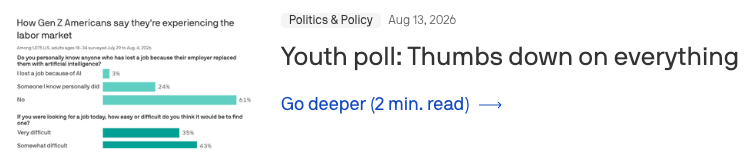
This is one of their articles. It has an image and a headline, so far pretty normal. But then it invites you to “Go deeper” and if you’re wondering how deep “deeper” is well, don’t worry. They tell you right by the “Go deeper” button that going deeper will, in this case, take you two minutes.
How deep can you possibly get in two minutes?
In an article titled “Robot book club” Mr. Johnston tells us that, while he was on vacation and reading a book for pleasure (Cooper’s “The Last of the Mohicans” — my late uncle’s favorite book, by the way) he found “the text was far too dense for casual vacation reading.” so … actually, you know what? You can just go deeper! It’s a one minute read! Here’s his story. Just read it.
Okay, if you refused to read it because you don’t like bulleted lists and emojis, I don’t blame you, so the TL:DR is that he had an AI reading buddy. Whenever he finished a chapter he would ask his AI to recap what happened in the book he just read.
I don’t think there’s anything wrong with looking up what a phrase means in a particularly difficult book, or many, many phrases, should the need arise (thanks Bourdieu). That is how you improve the skill of reading.
But if you’re reading a book for pleasure, and you’re not enjoying it, just don’t read that book! What these seems to imply is not that Mr. Johnston wanted to read a book but he wanted to have read a book. He wanted to be able to say “Ah yes, the film is wonderful, but have you read the book? Simply divine, oh you must read it, and in the original english, too. Delightful.”
(Maybe I’m being unfair. Maybe he knew my uncle and was reading the book to honor him, in which case, I apologize)
This, too, is reflective of a change in attitude towards the written word. As I said above about writing, the written word is now a chore — something to get over with.
We have transformed the miracle of humanity into homework. We have drained our children of enthusiasm for discovering new worlds in the words of another person. We have —
You know what? This is getting melodramatic. Let’s be blunt.
We’re dummies! And LLMs are just the tool to allow us to convince ourselves that we’re not dummies for a little while longer. Until it’s too late.
Oh no.
Oh dear.
What have we done to ourselves?


One response to “Oh no, oh dear, what have we done to ourselves?”
[…] come across as someone who is quite skeptical of AI (see my post “Oh no, oh dear, what have we done to ourselves?” for that perspective). So I’d like to clarify a little […]
LikeLike