The Sand Mandala is a Tibetan Buddhist art form in which a piece of art is made using colored sand:
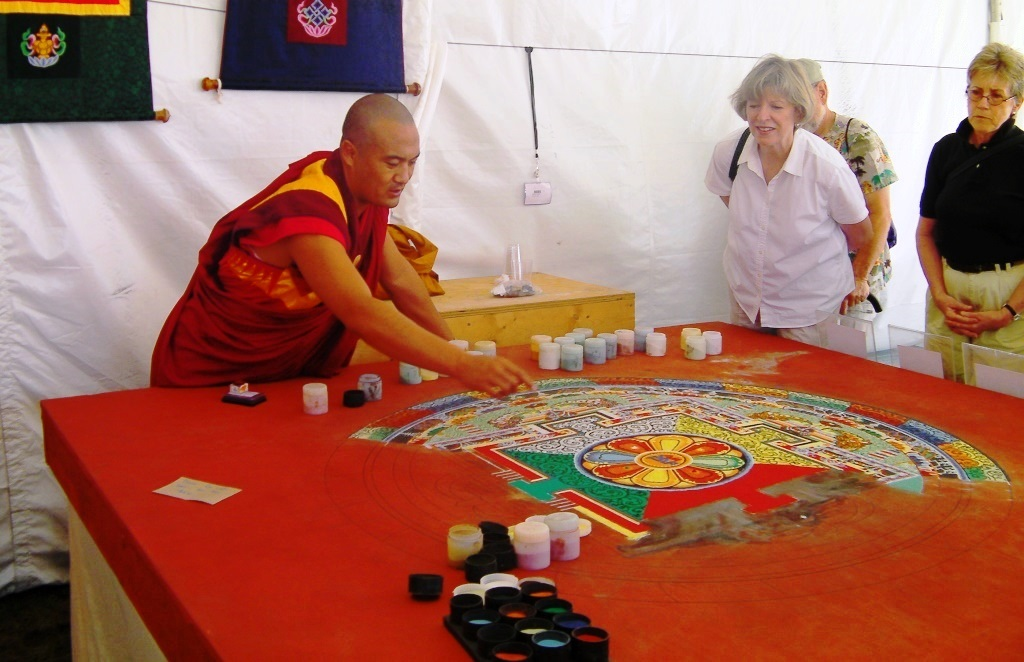
Although the art is full of symbolism, the medium is highly symbolic as well. A Sand Mandala is made using a heavier form of sand so a light breeze won’t destroy it (this is important since they can take weeks to finish), but there is no adhesive, no mounting, no glass case to protect it — nothing. The destruction of the sand mandala is just as important as its creation.
Recurring conversations
For a few years I managed the IT department for a theater chain. One of the problems that we struggled with before finding a solution was how to communicate with the appropriate people during a high priority incident. Eventually we found a way that worked for us and we were able to handle those much more efficiently.
I still work for the company that owns that theaters, but I don’t manage their IT anymore, and haven’t for around seven years. I still drop by the theaters, though, because I have a lot of friends there and I still care about them and what they do.
One night I swung by a theater and sat down in the manager’s office to chat with my friend. There had been an incident and he was lamenting that people hadn’t received notice in a timely fashion and he started brainstorming with me on how that could be improved.
And I was struck by the strongest sense of deja vu. I’d had that conversation before. Not that a similar one. I’m pretty sure I had this exact conversation with this exact person some eight or so years before. And we’d found a solution that worked and I just kind of assumed that it was done. We’d fixed it. We’d figured it out.
I left the theater in a funk. We’d worked so hard on a solution but it was just … forgotten. We’d tried to solve problems and they’d just become unsolved. This was especially hard for me because I focused so much on creating permanent solution. Everything was well thought out. Everything was documented with precision. We taught everyone how to maintain this documentation and these procedures until the end of time so that we’d never have to solve the same problem twice.
And yet, here we were. Solving the same problem again.
I went home and vented to my wife. I felt like nothing I’d done had mattered because it hadn’t stuck around. Why did I try so hard if it wasn’t going to, you know, STAY FIXED? I had meant to create a self sustaining system that would continue to improve the situation there forever (I read a lot of Toyota Way stuff) and I’d failed. What was the point?
Legacy is just another word for control
Percy Shelley’s “Ozymandias” is a short but powerful poem. Let’s just read the whole thing:
I met a traveller from an antique land,
Who said—“Two vast and trunkless legs of stone
Stand in the desert. . . . Near them, on the sand,
Half sunk a shattered visage lies, whose frown,
And wrinkled lip, and sneer of cold command,
Tell that its sculptor well those passions read
Which yet survive, stamped on these lifeless things,
The hand that mocked them, and the heart that fed;
And on the pedestal, these words appear:
My name is Ozymandias, King of Kings;
Look on my Works, ye Mighty, and despair!
Nothing beside remains. Round the decay
Of that colossal Wreck, boundless and bare
The lone and level sands stretch far away.”
I think most of us hope for some kind of legacy. Whether it’s something small like how we do our jobs, or something large like how we raise our children, we grasp for immortality with whatever means we have. Whether that’s creating a giant statue of ourselves, or leaving behind immaculate documentation about how to contact the appropriate people in a high priority incident.
(I know how stupid this sounds. I know that me talking about documentation as a legacy seems dumb. I’m dumb! What can I say. A very dumb thing led to a larger realization on my part so please ignore how dumb I am so that I can stop worrying about how dumb I look, and instead I can say this dumb little thing I learned without being quite so self conscious)
But what I came to realize is that focusing on creating a legacy, no matter how inconsequential, takes our attention away from what’s in front of us. Instead of seeing things as they are, we see them as we hope they will be seen. Take work — if I become wrapped up in “creating a self-perpetuating system” then I’ll be focused on how things will play out in the future — a future I can’t control and that will inevitably not include me at some point — instead of focusing on the needs of people around me.
Don’t worry about legacy. Worry about your Sand Mandala
I try not to get in the headspace of creating the perfect, self-perpetuating system anymore because I realize it’s pointless.
Instead I try to focus on the people I work with, the family I have, the friends that count on me (and I count on). And I try to create as excellent an environment for them as I am capable of creating. I focus on creating my own beautiful Sand Mandala. Not that I intend to tear it down myself, but I recognize that it will be torn down no matter what I do.
I still hope for some kind of legacy — mostly I hope that my kids remember me fondly. But I recognize that my legacy won’t be created by me — it will be created by the people around me. So why worry about it?
Had Ozymandias spent his statue money on people instead of statues, well, we probably wouldn’t remember him any more or less, but the people he saw every day would’ve appreciated it.
 Josh Boyles
One response to “On Legacies”
[…] … strange, but also, to me, appropriate given the themes of this book. Themes I would say I mostly agree with (although my explanation of it is much less thorough than […]
LikeLike