Liker and Convis’s “The Toyota Way to Lean Leadership” is a fantastic book about how Toyota develops leaders, and one of the things they call out is how important “self-development” is.
I wrote about this before, but I’ve continued to think about it and as my thinking has evolved I’ve created a kind of model that I want to put forward as it may be useful to others. None of this should be considered definitive, but it may be a helpful way to examine your own self-development.
The self developer model
I think there’s two key ingredients in self-development:
- Effort — how much time and focus you spend on activities that improve your skills (not how much time you spend working)
- Desire for correction — how eager are you to receive feedback, how do you respond to it, how do you implement it?
We can map this out in a four box model like so:
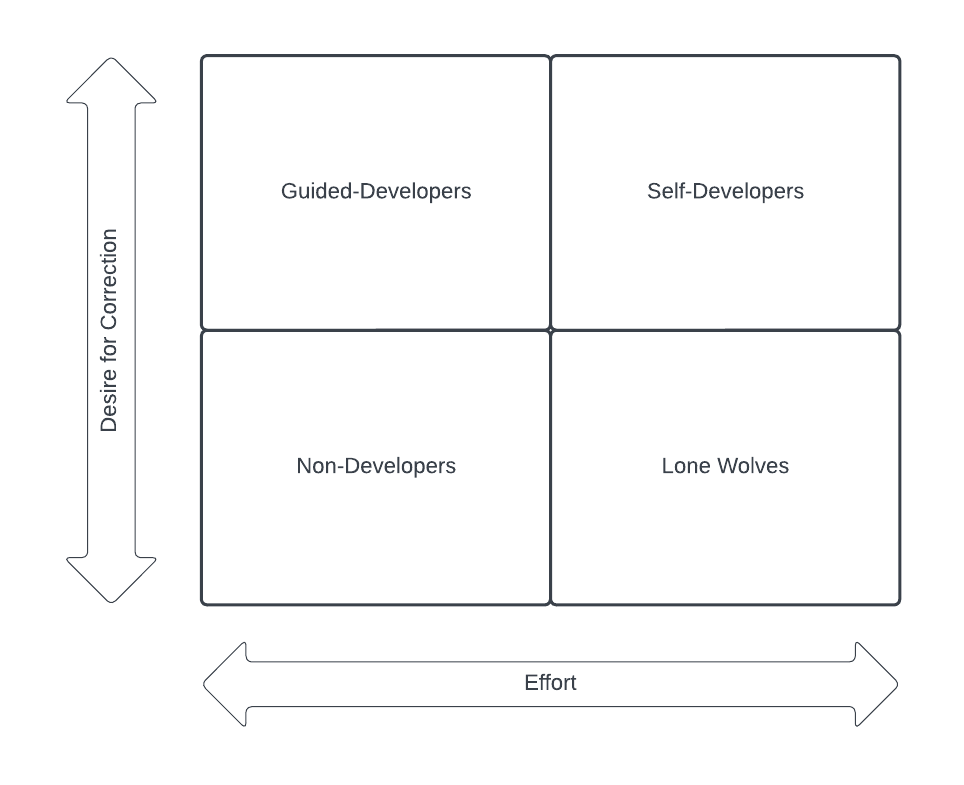
As you can see, this creates four basic types of developers. To explain them a little:
- Self-developers — High effort and high desire for correction. These people seek out feedback, take it to heart and do better. They dedicate significant time to improving themselves, incorporating the advice they’ve received and iterating on it to go beyond.
- Lone wolves — High effort and low desire for correction. These are people who dedicate significant time to improving their skills, but they don’t generally like feedback. These people can be very good at their chosen area of expertise, but they’re hard to get along with, and likely have significant blind spots.
- Non-developers — Low effort and low desire for correction. They’re in it for the paycheck. Punch in, punch out, as they say.
- Guided-developers — Low effort and high desire for correction. They are happy for feedback, they genuinely want to do better, but they don’t find time to improve themselves on their own. They can go as far as a good manager can take them, as long as that manager can give them plenty of attention.
Think about all the people you’ve worked with. Which quadrant would you say the majority of people fall into?
When I think of who I’ve worked with I’d say most people fall into the “Guided-developer” camp. Most people want to do better, and most people do what they can at work, but they don’t extend what they’ve learned beyond the confines of the job they’ve been asked to do.
The incredibly unscientific “what kind of developer are you?” quiz!
So let’s see what kind of developer you are! But remember, this is about self-development. Not everyone is currently working in the career they want to have long term. Take IT: someone might be on the helpdesk, but their real goal is to be a developer. In that case their development effort would be the effort they put in to becoming a developer. With that in mind, which of the following best describes your effort?
- I do what I’m paid to do, I take my breaks and try not to think about work on lunch and, when I clock out, I’m done for the day and my time is my own.
- If opportunities to do something I’m interested in come up at work I do my best to take them, and if work provides time or opportunity to study or build skills I take it.
- I interact with people doing what I’d like to do one day and find opportunities to do projects with them, or projects on my own initiative that allow me to develop the skills I’ll need — even if they’re outside of my normal day-to-day responsibilities.
- My manager knows what I’d like to do one day and I work with them to find opportunities to develop those skills at work, and I also spend some time at home building out those skills. I’m frequently excited to bring something I’ve perfected at home back to work.
- I live and breath my area of expertise — I’m constantly pushing the boundaries at work and at home if I”m not sleeping, eating, or handling family responsibilities I’m building out my skills.
OK, write down which number you think best describes you. Then, if you’re taking this really seriously (which maybe you should only take it semi seriously since this is all just me throwing stuff together, but still), ask a couple people who you trust to be honest with you to also rate you. Do they rate it differently?
Now for desire for correction. This one is tougher — you can probably tell because it has such an unwieldy name: “desire for correction.” Originally I was going to call it “feedback hunger” or something, but what I’m trying to get across is that it’s not just about getting feedback. It’s not just about “doing your job” better. Do you want to be better at what you do in general, regardless of the career outcome? Do you want to know what you’re doing wrong — even if it hurts to hear it?
As Sheldon Kopp said of therapy*:
… though the patient enters therapy insisting that he wants to change, more often than not, what he really wants is to remain the same and to get the therapist to make him feel better.
When we ask for feedback at work a lot of time we’re actually looking for someone to say “No, you’re doing a good job. Here’s one little thing but, overall, fantastic.”
(honestly, it’s the same when we ask our partners how we are as a partner, or our own parents how they think we’re doing as parents. Nobody wants to be told they’re terrible)
But a self developer, I think, craves correction — they want to be told what they’re doing wrong, and hopefully how to fix it, although if the person doesn’t know how to fix it they still want to know what’s wrong so they can try and fix it.
With that in mind, which of the following numbers best describes your desire for correction?
- I prefer to not worry about feedback. Either what I do isn’t that hard, or it is SO hard that no one else could possibly be qualified to give me feedback. Either way, let me do my job and keep it to yourself.
- Thinking back over the past year, my boss has given me some good feedback a few times and that was helpful.
- I participate in work-mandated feedback like annual reviews and whatnot, and I generally take them seriously. Sometimes something good even comes out of them.
- I really want to know how to do my job better — please, if there’s something I could do better just let me know. I really appreciate that opportunity to reflect that our work evaluations give us.
- Every time I do something at work, upon finishing it, I pause and reflect on how it went, what could have been better and what went well. I’ll frequently ask both managers, co-workers and even customers how it went, and what I could do better next time. I ask people to be blunt.
Write down your number, and maybe ask some other people that you trust which number they would use to describe you.
Now plot out your position on the model using the numbers you wrote down:
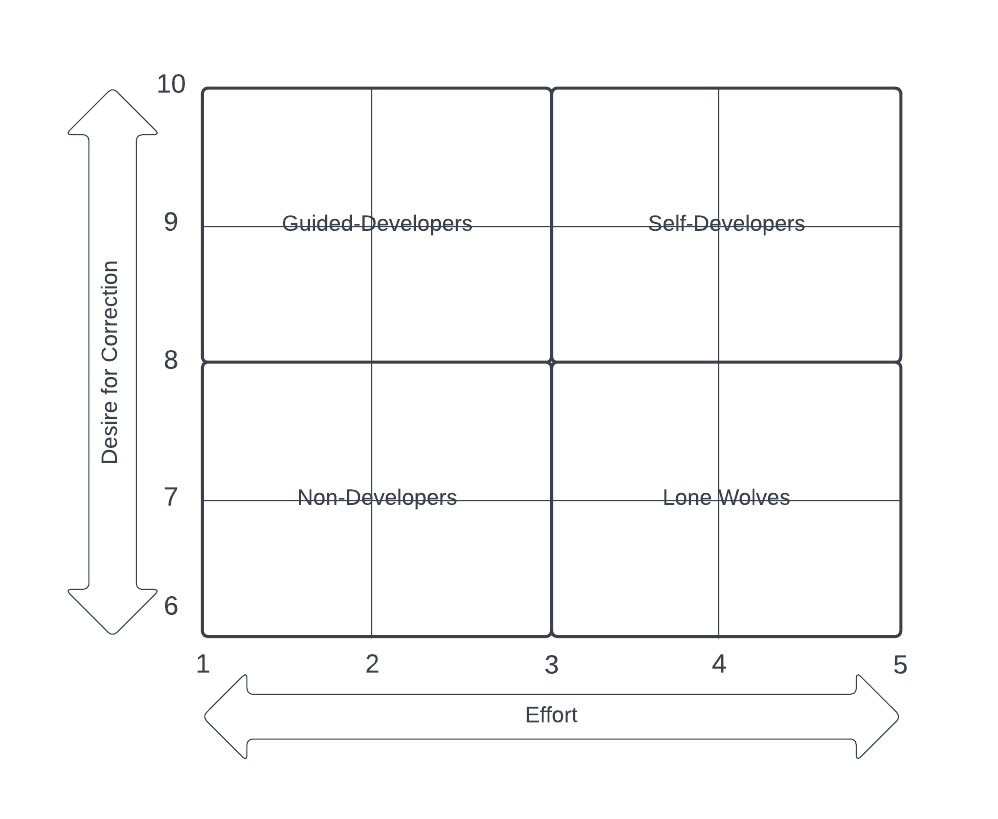
So which are you? A guided-developer? A self-developer? A lone wolf? I know you’re not a non-developer because, if you were, you wouldn’t be reading this blog post.
What good is this whole exercise?
This isn’t a scientific model or anything. No one is going to give you a “lone wolf” badge, and if you put “Self-developer” on your resume people are just going to roll their eyes.
The whole point is for you to get an idea of where you stand, and where you could work to improve. Are you a guided developer? Would you like to move into self-developer territory?
Then it’s a question of effort, right? And I don’t mean that in a “try harder at work” way. I mean it in a “You’ve got to put in the reps to get good” kind of way. Maybe you should set aside an hour to study at home. Or choose a project to work on in your free time that builds your skills. Or maybe even start a blog! I promise I’ll read your blog — at least the first few posts.
What if you’re a lone wolf? I’m going to be honest — in my opinion that’s harder to develop because you have to, well, try and develop humility, which is tough. Maybe just start by asking for feedback more. Reading a book from the Arbinger Institute, or “The lost art of listening.” Maybe challenge yourself to ask for feedback and then thank people, no matter what they say, without defending yourself.
The goal here is not to become the ultimate self-developer, up in the absolute top right of the matrix. If you think about it, that attitude might be a little unhealthy, bordering on obsessive.
Instead the goal is to figure out where you are, and if there’s room for healthy, sustainable improvement. It will probably be uncomfortable, but being a self-developer is worth it, because it’s learning a skill that unlocks almost any other skill.
FOOTNOTES
*The quote is from Sheldon Kopp’s “If you see the Buddha on the road, kill him.” The whole quote is instructive:
People seek the guidance of a psychotherapist when their usual, self-limited, risk-avoiding ways of operating are not paying off, when there is distress and disruption in their lives. Otherwise, we are all too ready to live with the familiar, so long as it seems to work, no matter how colorless the rewards.
And so, it is not astonishing that, though the patient enters therapy insisting that he wants to change, more often than not, what he really wants is to remain the same and to get the therapist to make him feel better. His goal is to become a more effective neurotic, so that he may have what he wants without risking getting into anything new. He prefers the security of known misery to the misery of unfamiliar insecurity
 Josh Boyles
One response to “What kind of self developer are you?”
[…] not going to go in depth about this one because I’ve written about it before (twice), but the reader’s digest version (remember when shortened versions were called […]
LikeLike