Let’s tell a story with pictures. What have we here?
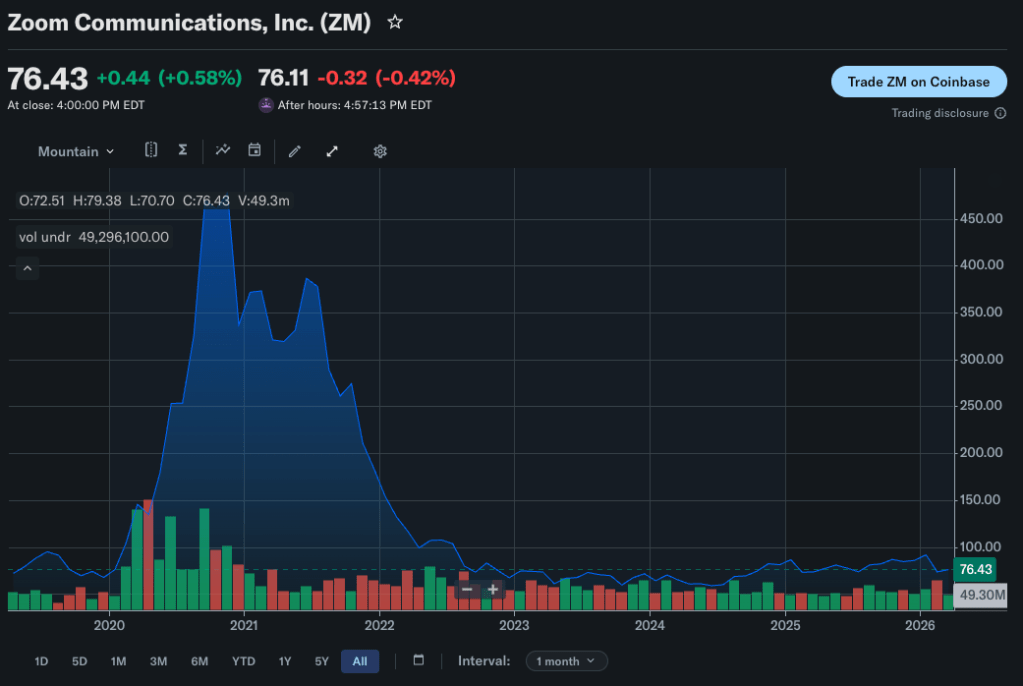
Why it’s the stock price for zoom, the videoconferencing software that reached almost $500 a share in the height of the pandemic, but has fallen to well under $100 as of 2026.
What we see is a belief, during the pandemic, that the world was fundamentally changing. That all business would be done via zoom, and that the way we work, go to therapy, go to the gym, buy clothes — that everything would rely on services like zoom.
And then the realization, before 2022 even arrived, that that wasn’t actually what was happening. Things were going back to normal, and so did Zoom’s stock, ending up right about where it started.
Let’s look at some more.
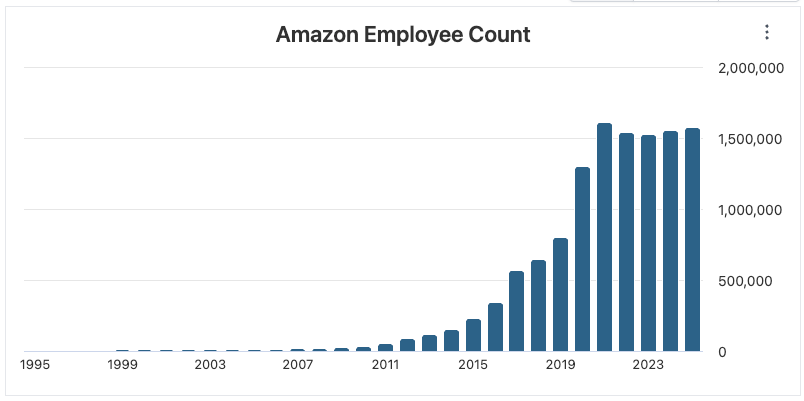
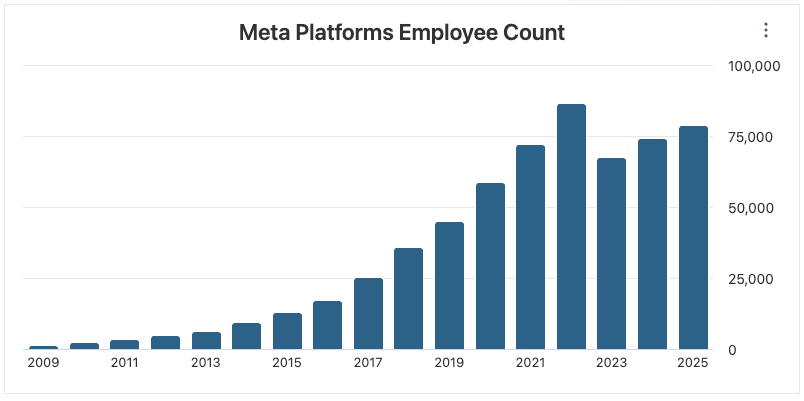
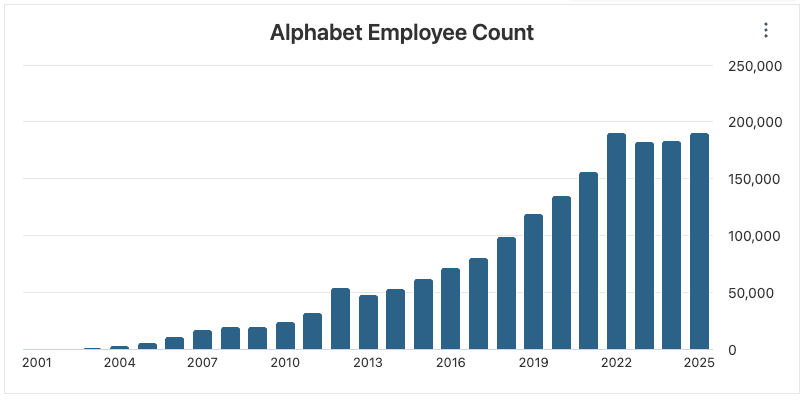
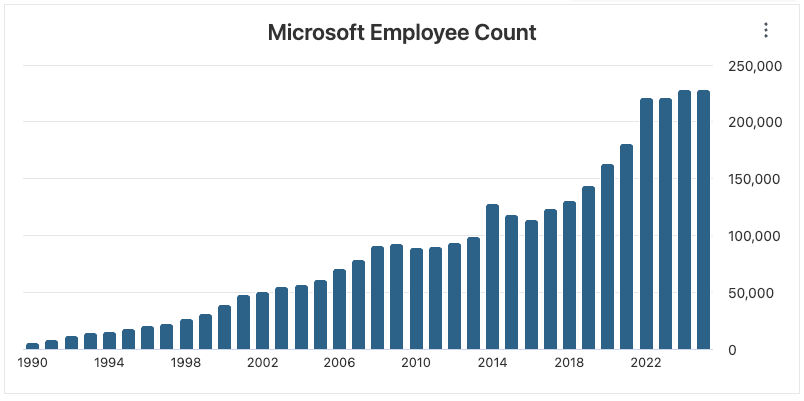
Amazon, Facebook, Google and Microsoft all felt like the same thing was happening. You can see headcount steadily rising year over year, then, around the pandemic, a sudden spike, followed almost immediately by an immediate drop in headcount (everyone except Microsoft) or hiring leveling off.
Everyone thought the world was changing. Everyone hired accordingly. Everyone was wrong.
In the years since these companies have normalized massive layoffs involving tens-of-thousands of employees. Recently they’ve blamed them on AI, but that’s just an excuse. All of them are still WELL above their 2019 headcount. All them them are still trying to undo the damage they did by assuming the world was changing when it wasn’t.
What do beer and technology have in common?
Not to beat a dead horse, but these are the same people who are trying to sell us AI. This is the second time in a decade that they are spending billions and telling us all that it’s because the world is changing. They were wrong last time, and, in all honesty, last time should’ve been way easier to get right. It wasn’t about some fancy new technology, last time was literally just about supply and demand.
In “The Fifth Discipline,” Peter Senge dedicates a chapter to what is called “the beer game,” which he traces back to MIT’s Sloan School of Management in the 1960s.
In “the beer game” participants are either managers of a grocery store, or a beer supplier, or managers of a brewery. Every week the grocery sells around four cases of a specific brand of beer. The “inciting incident” of the game is that one week you sell eight cases of this beer instead of four.
Because you have 12 cases in stock you’re OK — you’ve got some buffer. You order some more to replace what you lost, and call it good. But next week you also sell 8 cases. And you continue to sell 8 cases every week after that.
That’s the only change — a one time increase in demand. It doesn’t continue to increase, nor does it fluctuate. It bumps up from four cases to eight. That’s it. And yet, due to the delays in communication and shipping, it always leads to trouble. As Senge summarizes:
In the last twenty years, the beer game has been played thousands of times … on five continents, among people of all ages, nationalities, cultural origins, and vastly varied business backgrounds. Some players had never heard of production/distribution systems before; others had spent a good portion of their lives working in such businesses. Yet every time the game is played the same crises ensue. First, there is growing demand that can’t be met. Orders build throughout the system. Inventories are depleted. Backlogs grow. Then the beer arrives en masse while incoming orders suddenly decline. By the end of the experiment, almost all players are sitting with large inventories they cannot unload…
The point of the beer game is that overreacting to one time changes leads to drastic down stream consequences that can echo for months or even years.
We’re still in the echo from the last over-reaction of the tech industry, still feeling the shocks as people who had a job, or assumed there was a job for them after graduation, suddenly find those jobs have evaporated — annihilated in the tens of thousands by shortsighted tech executives who made massive mistakes, then tried to blame AI as they hastily tried to correct them.
That’s not to say AI isn’t causing disruption in the job market. We have seen a few things:
- AI is decreasing the number of entry level positions available for recent college grads
- Companies are letting people go assuming that AI can replace them, only to later rehire them when AI doesn’t live up to the hype
So what can YOU do? How do we use AI effectively, without falling into the same traps that the tech leaders (who were wrong literally just a few years ago) are themselves falling into?
Taking the Long View
If we were to summarize, the way to avoid these traps is to think long-term, not short term.
Tech leaders aren’t dumb. They make these wild predictions, and back them up with wild hiring and firing practices, because they need to make news to move their stock (which is typically how they are paid).
Announce that you’re hiring programmers to develop the next generation of AI and enter into this emerging market? Stock goes up. Announce that you’re firing a bunch of developers because the AI can now do most of their work? Stock goes up. Announce that you’re firing tens of thousands of people because ” you’re going all-in on AI?” Stock goes up.
Here’s an example. Block, Inc. (maker of Square) has had a rough year, but on February 26th they announced they were laying off almost half of their staff (roughly 4000 people). What did that do to the stock?
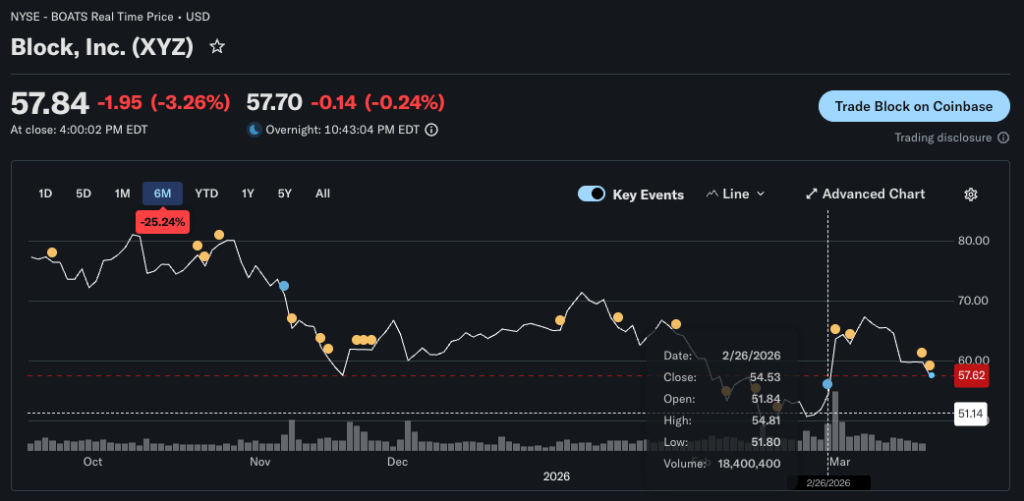
I’ve highlighted the 26th there, and though they received a ton of bad press the move was quite popular with investors, undoing several months of declines (although the increase didn’t stick around).
You would think that firing half of your staff would be a bad sign. You’d think it would indicate that leadership had either made poor hiring decisions in the past, or they were making poor decisions now. That’s not how the stock market read it — at least for a month.
So don’t think like a CEO of a public company. Think long term. For Example:
Short Term: People are the past, AI is the future!
Long Term: I feel like I’ve heard that refrain before.
Almost every major advance in technology has been pitched as being able to reduce costs and/or headcount. In almost every case that has been wrong.
- In the 60s and 70s mainframes were supposed to reduce back office and clerical costs. Instead those costs remained the same, but IT costs were added on top of it.
- The advent of the personal computer was also thought to increase productivity, instead productivity growth slowed. As Robert Solow famously said “You can see the computer age everywhere but in the productivity statistics.” (we’ll come back to this article)
- ERP systems were (and often still are) MASSIVE failures. They take longer than anticipated, they cost more, outright fail over half the time, and even when implemented can lead to losses instead of gains.
We could add the internet and e-commerce, Cloud computing, and more to this list, but let’s go back to that article that quoted Solow. As the authors put it:
Newfangled computers were actually at times producing too much information, generating agonizingly detailed reports and printing them on reams of paper. What had promised to be a boom to workplace productivity was for several years a bust. This unexpected outcome became known as Solow’s productivity paradox …
Generating too much information? Agonizingly detailed reports that go on for pages and pages? Does any of this ring a bell in our modern age?
Short term thinking is always looking for something that can be a big headline — something that’ll goose the stock price. Long term thinking recognizes that everything takes time — even small organizations have more in common with a cruise ship than with a speed boat. Even if AI performed exactly as promised, it would take significant time to integrate it into a business.
And the worst part is, AI isn’t performing as expected. One study found that even though 70% of firms are using AI, over 80% of those report no impact on either employment or productivity.
AI is an amazing tool. So was cloud computing, and the internet, and the PC, and even mainframes. All of them were helpful and made huge changes in the long run. All of them took a while to fully utilize, and all of them cost money — they didn’t save it.
Long Term AI is an amazing tool. Short term it’s a cudgel
Satoru Iwata, former president of Nintendo and all around incredible person, once gave one of my all time favorite quotes:
If we reduce the number of employees for better short-term financial results, employee morale will decrease, and I sincerely doubt employees who fear that they may be laid off will be able to develop software titles that could impress people around the world.
There’s that concept again — short-term.
In the HBR article from above about how leaders are often deploying AI based on potential, not performance, the authors summarize some of the risks:
While announcing layoffs or slower-to-no hiring because of AI may be appealing to the press or to investment analysts, it has important negative consequences. It may, for example, suggest to remaining employees that they will soon lose their jobs too. Perhaps that is intended, but it will likely prevent them from exploring how best to improve their own work with AI. Falsely claiming that AI is the reason for layoffs may also nurture cynicism among employees about AI and its implications. Even the larger society may become more negative about AI than it already is; one 2025 survey suggested that half of Americans are more concerned than excited about the increased use of AI in daily life. Increased concern may lead consumers to veer away from products and services that make use of AI.
Do you think AI is a poweful tool? Does it have potential to improve people’s lives? Great. Stop shooting yourself in the foot by buying into the hype and deploying it in ways that are destined to SLOW adoption. Instead, approach it with a long term view, for you and for your company.
- Be aware that, in the short term, AI will cost money, not save it
- AI can replace tasks, not people. Don’t assume people are just a collection of tasks.
- People who are afraid won’t produce good work, and will run from AI.
Here’s how I believe an ideal AI rollout would go.
- Leadership would set the expectation that, in the short term, AI will cost money, not save it.
- Because you’re not reducing spending the benefit of AI will be in other areas, primarily:
- Automating away drudgery
- Shortening task times
- Giving people more time to focus on value-add tasks that require human creativity
- All those things will improve jobs for the people who have them, leading to higher job satisfaction which, in turn, leads to higher productivity
- IF people are happier and more productive they can potentially handle more work in the same amount of time, defraying future costs as you can expand capacity faster
One last short term problem
The final short term problem goes all the way back to the beginning, when we acknowledged that AI is hoovering up entry level positions.
Short term, this saves companies money.
Long term, it will lead to a serious problem. If companies only hire mid-to-high level employees, where are those going to come from? In ten to twenty years when those employees start retiring, who will take their place?
All the entry level employees will have been chased out of the industry — told to become a plumber or a nurse instead of working in IT. There won’t be anyone capable.
At that point, one of two things will happen, depending on who is right.
- If AI boosters are wrong, and it doesn’t continue improving forever, then you will have work that needs to be done but no one capable of doing it, and no one capable of training new people to do it. You will have to find and hire employees and spend years just training them until they are capable of the job you really need — during the training they won’t be able to meaningfully contribute, and systems will degrade waiting for them to achieve mastery. You will lose years or even decades of productivity.
- If AI boosters are right, and AI improves enough that it can take over the jobs of your senior engineers, then you will hire AI to do the work, and you will be 100% reliant on the AI providers to keep your business running. If they raise their prices where would you go? Who could you find to do the same work?
Well, no one and no where. Training an advanced AI requires massive datacenters and costs billions of dollars. You can’t do that yourself, but luckily when those datacenter bills start coming due the AI companies will have a captive market of people who literally cannot possibly avoid paying them whatever they ask.
Neither option sounds particularly great, so the smart move is to avoid either option and, instead of taking the short term savings of not hiring an intern, take the long term view and create a talent pipeline that your company can depend on.
AI is just a tool, but great people are what make great organizations.
 Josh Boyles