Let’s get this out of the way up front: I absolutely loved Thinking in Systems by Donella Meadows. Insightful. Well written. Entertaining. Eye opening. Not that long. It has everything anyone could want! You should read it.
NOW, let’s get into the super long-winded discussion of why this book is great, and to start we’re going to talk about what systems thinking is.
So why does, like, stuff happen?
We are typically linear thinkers. We see things as direct cause and effect. The world looks like a giant Rube Goldberg machine to us.
We assume that an event causes other events. But that’s not actually true. And the prime example graces the cover of Donella’s book:
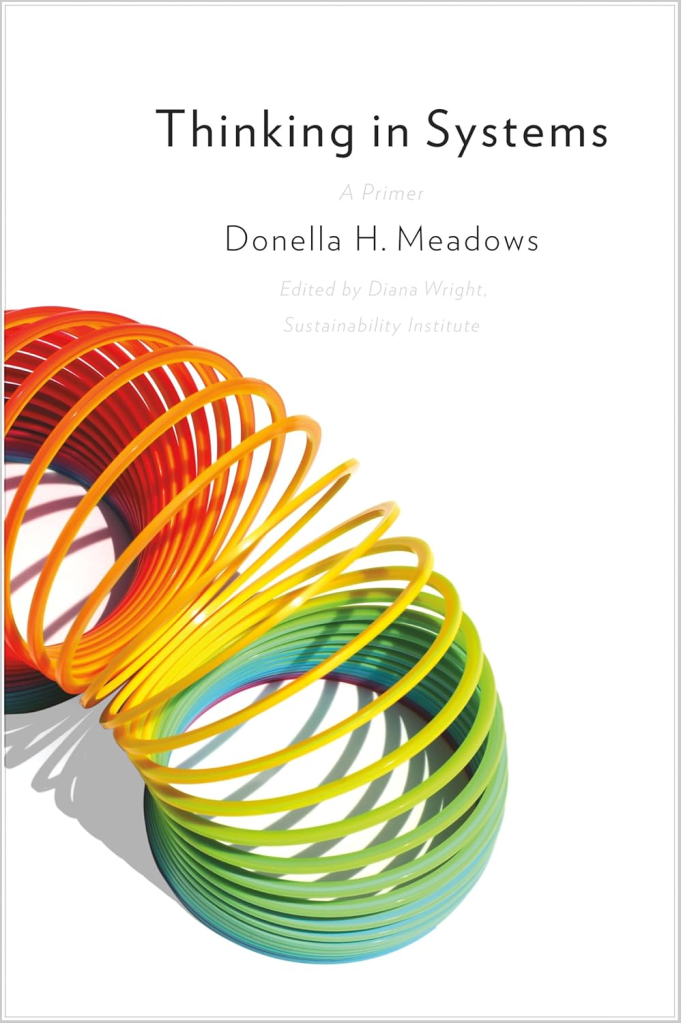
She explained that in introductory classes she would bring out a box with a slinky in it. She would rest the slinky on her palm, grab the top with her other hand, then swiftly swing her palm away from underneath the slinky. What happened? The slinky would bounce. And she would ask a simple question:
“What made the slinky bounce?”
Her students typically answered with one of two things. Either it was her moving her hand, or gravity.
Then she’d put the slinky down and pick up the box it came in. She’d repeat the experiment, but this time, because it was a simple box, nothing would really happen. She just continued to hold the box.
The same actions produced two different events. Why? Because of the makeup of the object being acted upon. The way it behaved wasn’t entirely defined by the actions on it, but by what the item itself was.
In this very simple example the slinky and the box are SYSTEMS, which she defines broadly as “An interconnected set of elements that is coherently organized in a way that achieves something.”
The purpose of the box is to hold a slinky. Because of that it needs to be relatively sturdy, colorful enough to draw the eye, cheap enough to insure a profit, etc. And these requirements for that system also made it rigid so that when she let go nothing happened.
The purpose of the slinky is to be a cheap toy that can do like …. three different things. It needed to be cheap as well, and coiled, and springy, And those characteristics meant that it behaved differently from the box when acted upon.
Everything (well, almost, we’ll talk about that in a second) is a system of some kind, and the goal of systems thinking is to help you understand that, map out systems, and understand why they behave the way they do (to a certain extent).
Let’s find some systems!
A “System” has three main parts:
- Elements
- Interconnections
- A function or purpose
A car, a book, a corporation, a children’s rugby team, a galaxy, all of these are systems. But a random collection of elements that DON’T interact with each other in any meaningful way — that’s not really a system. A toy may be part of a system of some kind (maybe a “child amusement” system, or perhaps “a nerd status signifier” if they’re Star Wars toys, still in the box), but a pile of toys randomly thrown in a field is not.
For systems thinking there are two incredibly important types of elements and interconnections that actually get names. These are stocks and flows.
A stock is some amount of something. It could be something physical (amount of water in a reservoir) or it could be something conceptual (good will).
Flows are what replenish or drain a stock. Going back to our reservoir, refilling flows might be snow melt, rain water or a spring. Draining flows might be irrigation and evaporation. These things are pretty simple to understand, but conceptual stocks are more interesting.
Take “good will.” Maybe I’m talking about the amount of good will a waiter has with some customers at a restaurant. The good will probably has a high correlation with tip amount, but even before the customer sits down that good will can start draining if they take too long to get seated.
Think of what else would affect your store of good will towards a waiter. Seriously, take a minute and say aloud five things that would either drain or fill your good will. Here’s my list:
- Clarity of communication
- Willingness to answer questions and take time
- Length of time to receive food
- Quality of food
- How long I have to wait for the cheque
Obviously there’s a bunch more, but those were the first five that jumped to mind. Hopefully you’ve noticed that … it’s not a very fair list! About half of it isn’t even something the waiter can do anything about. How are they going to change the quality or speed of the food? They can’t!
Or CAN they? See, that’s the brilliant thing about systems thinking. A waiter, going through what impacts service, would realize that much of their livelihood depends on the quality of the kitchen — and they make take actions to influence the product coming out of the kitchen (or simply find a different job with a better cook).
So what? What can you do with a system anyway?
When talking about stocks and flows Meadows introduces the concepts of “feedback loops.” A feedback loop is when something within the system causes some action to occur. Feedback loops can be reinforcing (more of something produces more of the same thing, like population growth) or balancing (when you approach a limit a flow reduces).
The prime example of a feedback loop is a thermostat. You have a room with a thermostat and a heater. When the temperature (the stock) dips below a certain temperature (due to flows such as a drafty door or bad insulation) the thermostat kicks on the heater.
The heater pumps in heat (another flow) which changes the temperature until it has returned to the desired ambiance, at which point the feedback loop signals the heater to stop.
This is one of the simplest examples of a feedback loop and a system out there, but think for a second. Now that you’re looking at the full system, let’s say you want to save money and run the heater less. What would you do?
You would probably caulk around the windows. Maybe install new double pane ones. You might put in better insulation, or change out the door and add a better seal around it. The great thing is that, with your feedback loop, you can try one experiment (maybe a new seal), and then time how long it takes for the heater to run, and thus now if that actually made a difference.
Or, instead of addressing the out-flows, you could address the inflows. Maybe get a more efficient heater. Or simply set the thermostat lower and tell people to wear a sweater.
The point is, when you articulate how a system functions it allows you to look at more solutions. Painting a more complete picture encourages you to, you know, actually look at the whole picture!
Let’s go back to a conceptual stock. Let’s say you want to increase job satisfaction on your team — that is your stock. What are the flows? Think about your own work for a second. What things make you glad to have your job? And what things bring you down?
Filling Flows
- Paycheck, baby!
- Time off
- Meaningful growth
- Engaging work
- Good coworkers
Draining Flows
- Early mornings (or late nights)
- Difficult customers
- Tedious work
- Paperwork
- Mandatory training
Much like the restaurant above, as you start mapping this out you’ll see new opportunities to make work better, and new ways to eliminate or reduce flows that make it worse.
Honestly, you should read the book
I could go on and on, but the book was incredibly enlightening, and I can’t reproduce her magic here in a blog post. What Donella talks about is actually the theoretical framework that underlies so much of what successful organizations have done largely through intuition.
Take “The Goal” by Eliyahu Goldratt — a book about stepping back and looking at a whole system and prioritizing the limiter instead of maximizing each individual link in the chain at the expense of the entire system. It’s systems thinking!
Or Toyota Kata, which skips past the tools that have gotten so much attention for how Toyota succeeds and asks the question “Where do the tools come from? People! And where does Toyota get good, problem solving people? Toyota Kata!” That’s systems thinking too! Looking at the whole system and finding the stocks (of creativity or problem solving people) and the flows that feed them (the unique way Toyota trains and manages their people).
Systems thinking is a foundational skill, and I highly recommend you give it a whirl.
 Josh Boyles