Do you know where the phrase “I’m surrounded by idiots” comes from? I couldn’t find the original usage, but it was super easy to find what popularized it:
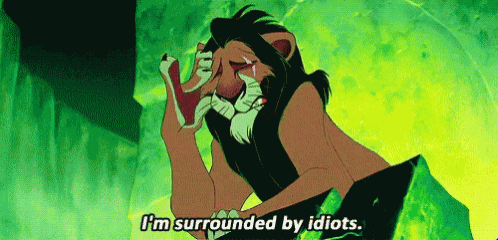
Which is hilarious, but I want to take a second and look at the context. Scar had set a trap so the hyenas could kill Simba, or, as he put it: “I practically gift-wrapped those cubs for you, and you couldn’t even dispose of them.”
How many times have you heard a manager (or parent, or teacher, or coworker) say something following Scar’s exact pattern: I did X for you, and you couldn’t even do Y. I laid all the parts out, and you couldn’t put them together. I put it on your calendar, and you couldn’t even make it on time. I wrote this simple checklist for you, and you couldn’t even follow it.
What’s interesting is how the hyenas respond: “You know, it wasn’t exactly like they was alone, Scar. What are we supposed to do? Kill Mufasa?”
Scar asks why they couldn’t do a simple thing, and they respond with a valid counterpoint — the simple thing you wanted us to do wasn’t actually that simple. There were other factors in play.
Or were they actually just idiots?
Spoiler alert: they weren’t
Around 1925, researchers had an epiphany. What if some workers were just more “accident-prone” than others? Could this “accident-proneness” be measured? Tracked? And if it were, could we then assign these “accident-prone” workers to jobs where their accident-proneness would be less likely to cause disasters? Maybe they could like … stuff pillows or something.
So they got to work, and spent the next 50 years building out this accident-tracking mechanism. There were databases created, and within companies each employee had a sheet that tracked every little accident that occurred in their wake. When the researchers found that some employees DID have way more accidents, they felt they were on to something, and doubled down. But they were overlooking one thing.
Take a bus driver. Typically bus drivers have specific routes — one bus driver might drive through the suburbs, while another might drive through the city center. The researchers realized that the bus drivers with safer, less crowded routes were all fantastic and that the accident prone drivers were almost all the ones driving through downtown — where there were significantly more opportunities to have accidents. They realized it wasn’t the people that were accident prone, it was the circumstances. If you swapped an “accident prone” bus driver to the suburbs, their accident-proneness disappeared. A safer, suburban bus driver who was transferred to the city, suddenly developed an acute case of accident-proneness.
To put it another way, were the hyenas idiots? Or did their circumstances make failure likely? I mean, not to spend the whole blog post talking about The Lion King, but when they’re given a different task — say, starting a stampede — they actually perform it to perfection.
Why do people screw up?
The story about accident-proneness researchers comes from a book that I consider one of the most fantastic hidden-gem books I’ve ever read: Sidney Dekker’s The Field Guide to Understanding ‘Human Error’.
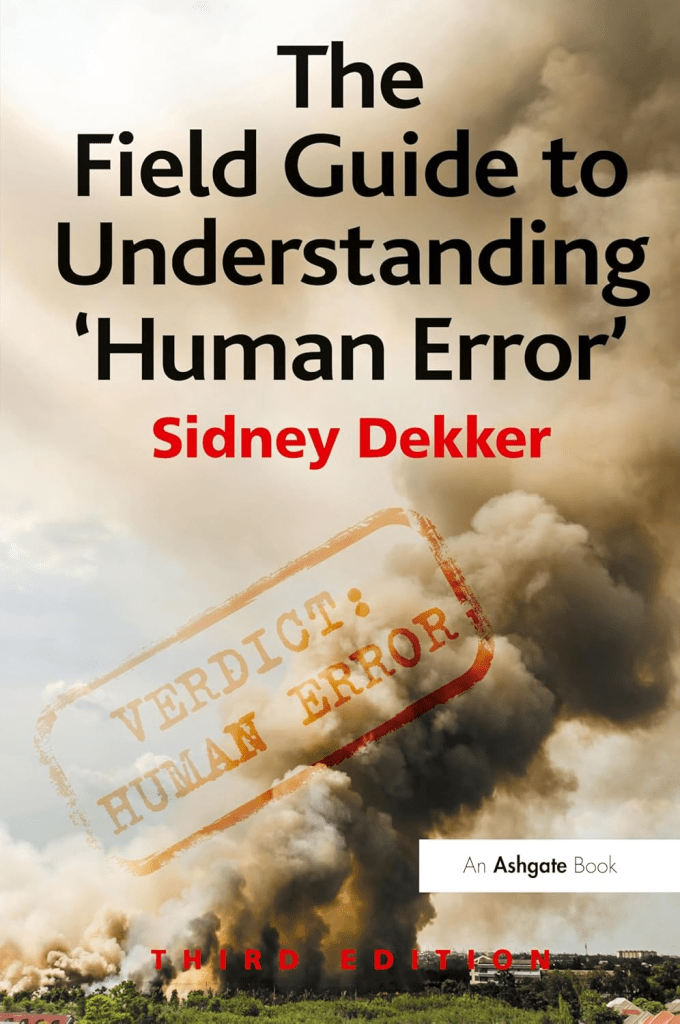
Listen to some of these Amazon reviews, about what is essentially a textbook:
Open your mind. This is a must read for anyone that deals in a world of errors.
Completely mind blowing. This book plus Dr. Conklin’s pre accident investigations has completely altered my thinking.
Fundamental! Sidney Dekker é, de longe, o melhor autor sobre a nova visão de segurança e fatores humanos.
What’s so mind blowing? Dekker talks about two different views of “human error” — what are conveniently called the “New View” and the “Old View.” To summarize the difference:
- In the Old View, ‘human errors’ are the cause of most of your trouble. People, in this view, are a problem to control. People’s behavior is something to control, something that you have to modify. You might believe you have to start with people’s attitudes, because those influence their behavior. So you try to shape those attitude with posters and campaigns and sanctions, which you hope will impact their behavior and reduce their errors. You might even elect to sanction some people under your … policy (even though there is generally no evidence that any of this works).
- In the New View, the behavior which we call ‘human error’ is not a cause of trouble. It is the consequence, the effect, the symptom of trouble deeper inside your organization. The New View assumes that people do not come to work to do a bad job. So when there are bad outcomes, you must look beyond those people, at the conditions in which they worked at the time. You and your organization may well have helped create those conditions. Leave those conditions in place, and the same bad outcome may happen again — no matter how many sanctions you impose, posters you put up or safety attitude campaigns you launch.
Both the old view and the new view admit that people make mistakes, but HOW they view those mistakes is very different. In the old view, the ‘human error’ is entirely the fault of the individual. They did something (or didn’t do something) and if they’d just been better they wouldn’t have done that.
The new view takes ‘human error’ and places it firmly within its context. It starts with the assumption that people want to do a good job (this is called the “Local Rationality Principle” and is well established), and then asks a question: if they didn’t want to screw up, what led to them screwing up?
So what DOES lead to them screwing up?
In Atul Gawande’s “The Checklist Manifesto” he looks into an incredibly important issue: why does ‘human error’ lead to so many deaths? To do this, he started tracking and following up on errors.
What he found was kind of surprising — it was shocking there weren’t MORE errors.
In one hospital, for example, in a “crash cart” (think of it as a big toolbox full of medicines for when someone is dying) he found that they had nearly identical syringes of medication next to each other in a drawer. The only differentiator was a tiny label on the bottle itself.
Imagine someone is literally dying in front of you and a doctor asks you to get 5 CCs of … let’s say Adrenaline (I just watched Pulp Fiction). And Adrenaline is in a drawer full of little bottles, ordered alphabetically, right next to Adenosine and Amiodarone. The patient is flopping around, there’s a significant other in the background crying, the doctor is shouting at you while he shouts at someone else to get the big ol’ shocker pads (I’ve run out of medical lingo). The heart rate monitors goes BEEP BEEP BEEEEEEEEEEEEEEEEEEEE … and he yells at you again “NURSE! 5 CCs ADRENALINE NOW” and hold out is hand.
Are you going to go “Hold on one second, doctor. I need my reading glasses because these labels are 5 pt type. Hold on. OK, this one says ….” or are you going to grab a bottle, squint at it, and hand it over?
What Dr. Gawande found was that when you introduced simple fixes (such as reorganizing a crash cart and, obviously, adding checklists) you could drastically reduce deaths attributable to ‘human error.’
The fix wasn’t to change behavior. The doctors were the same. The patients were the same. The context changed, and that is what wound up changing the result.
People screw up because they are doing their best, and the system that they have been put in has problems.
They KEEP screwing up because, when they screw up, we don’t look at the system. If we’re following the old view we instead go “That’s a bad apple” and we discipline them, and shake our heads, and eventually we fire them. But none of those actions fix the problem itself. They take the responsibility away from managers and put it on the individuals. But the individuals have no power to fix the system they’re in. It’s a vicious cycle where screw ups happen, and we shake our heads, and say “It’s definitely not MY fault,” and nothing ever gets better.
So how do we fix it?
Listen, The renowned Sidney Dekker (and Atul Gawande, and many others) wrote whole BOOKS about fixing this issue. And I cannot recommend Dekker’s book enough. Buy it and read it!
But I will give you something to start with.
The very first thing is to adopt the New View. Never, EVER look at a mistake as ‘human error.’ Instead, dig into it. As Dekker puts it:
Make sure you ask “is that so?” whenever you, or other people, seem to have reached a conclusion about ‘human error.’ Do so relentlessly. Never stop questioning.
So the next time there’s a problem, take what will definitely feel like WAY TOO LONG and really, really dig into it. Use 5 whys. Consult with other people. Etc. And as you do so, don’t let yourself say ‘human error.’ Instead, find a way to improve the system you’re in charge of.
Here’s a side effect of this point of view: if you have someone who is “accident-prone” they are no longer a hindrance. They are someone who is amazing at discovering the limits of your current systems! Just like Netflix used to intentionally break their systems with their “Chaos Monkey” program, you will have someone you can unleash on a new procedure or environment to find out what can be better. Just don’t call them “Chaos Monkey.” Turns out people hate that little nickname.
Once you have discovered the root cause, it’s time to start redesigning the environment. Dekker is a great resource for this, but there are others as well. I’d especially like to call out The Checklist Manifesto (mentioned earlier) as well as Mike Rother’s “Toyota Kata,” which teaches “scientific thinking” — a way to iterate towards a solution to a problem.
Both of those are great, as long as you don’t default back to “The person is the problem!” The new view is not easy to maintain. You will find yourself saying “Listen, I know you said no bad apples but uh … this apple? This specific apple that I’m referring to? Even you will admit that’s a bad apple.”
Nope. I will admit no such thing! Because to admit that is to abdicate my responsibilities as a manager. It is, ultimately, to say “No, things can’t get better.” And trust me, they absolutely can.
 Josh Boyles