AI poses a unique conundrum. It can do a lot, but it’s not always 100% accurate. It can provide convincing text, but it can’t reliably provide insight. I think a lot of people instinctively feel like a lot of their work could be handed off to an AI agent, but they’re not sure what work.
There are two different perspectives on how AI should be used. These are:
- How should I, as an individual, use AI?
- How should my organization use AI?
The answer to these questions is not the same — in fact, it’s different enough that it warrants two different blog posts. We’re going to look at question 2 here. How should your organization use AI?
To figure out how to use AI we need to find out what kind of work your org does, and if AI is a good fit for that. First, let’s figure out what you do, and what of that is really unique to your org.
Finding what matters: The Purpose Alignment Model
In “Stand Back and Deliver” the (four) authors discuss a really cool tool called the “Purpose Alignment Model.”
(The book itself is kind of a toolbox of various things you can use to “accelerate business agility” and has some other good ideas too)
The Purpose Alignment Model helps you look at the various things you do at work, and decide how to approach them. It’s a four box model that looks like this:
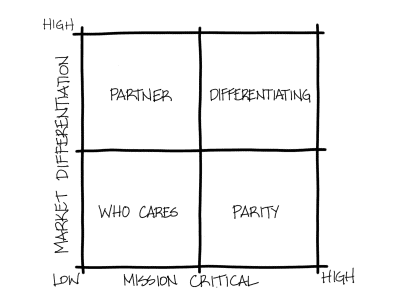
Basically every task needed to run an organization can be plotted on this matrix, using two questions:
- Is this mission critical? What that means is, do you need this to run this business? Will everything grind to a half without it?
- Is it market differentiating? Does this set you apart from your competitors? In the book they ask a simple question to determine this: is how you do this something you might put on a billboard?
How you answer those questions determines what quadrant you land in:
- High mission critical, low differentiation: the prime example of this is email. Yes, you absolutely need it. But you would never put “See how well we email” on a billboard, so the goal is just to do what everyone else does, in other words, to achieve Parity.
- High Differentiation, Low mission critical: this is often (but not always) the realm of technology. For example, let’s say you have a great class teaching how to garden in an apartment. The content itself is the primary differentiator, but there could be ways to deliver it in a unique manner too. Maybe there’s a new competitor to youtube that offers 360 degree video. In that case, you’re going to partner with that company to offer your unique content in their differentiating format.
- Low mission critical, low market differentiating: something like how you clear the snow from your employee parking lot. It would never go on a billboard, and it’s not the end of the world if it doesn’t happen. This is who cares territory — just go with whatever is cheapest, or maybe even skip it.
- High differentiating and high mission critical: this is whatever sets your business apart, the true differentiating value proposition of your business. This is what you need to own yourself.
Let’s take an example of a Bakery that delivers bread every morning — there’s no storefront. What does it take to run a bakery?
- You need a building
- You need to make bread
- You need to deliver bread
- You need to pay your employees
- Etc.
Before I reveal the answer, try and place these on the matrix yourself. Where do you think they go? For my money, it looks like this:
- Building — parity (you just need somewhere you can put a stove and whatnot, nothing fancy)
- Make bread — differentiator, probably (the main thing that would keep people coming would be delicious bread, this is something you do that is unique. If your customers didn’t care about the bread quality you could buy wonderbread and deliver it, but then there’s nothing differentiating at all)
- This is where the “billboard” test comes in. If you made a billboard, would it be a big picture of a steaming loaf of fresh bread? Or would it be a picture of a loaf of bread on someone’s porch? How you answer that question would inform which is the differentiator and which is partner.
- Deliver bread — this could be differentiator or partner, depending on resources available to you, but probably you’d just partner with a delivery company so that you don’t have the added overhead they deal with (or doordash or whomever).
- You need to pay your employees — parity. It needs to happen, but it’s never on a billboard.
What this example shows us is that a company will typically want to focus in on something and make that their “differentiator” — the thing they’d put on a billboard. And you NEED to own and protect that thing.
What happens if you don’t protect your differentiator?
I worked for a theater chain for a while and managed their IT. One story came up a lot as a cautionary tale.
Some theater leadership was attending a conference and saw a company that offered assigned seating. Assigned seating was normal for sports venues and operas and the like at the time, but it was unheard of for movie theaters (which always used “General Admission” — first come first served).
This leader saw the assigned seating and thought “Our group should do that!” So they went back and talked it over as a team and decided to have the company that made their back-office theater software build it for them. This software was actually the backbone of the majority of theaters in the US. They decided to partner.
They rolled it out, it was a big hit, and for six months everyone wanted to come to their chain. But the software company only agreed to keep the feature exclusive for six months. After that window they rolled it out to everyone else and what had been a differentiator (literally the only place in the state with assigned seats) became a parity feature. Everyone had it.
Had they built it themselves they would’ve, at the very least, gotten a longer exclusivity window. They could’ve potentially protected it with patents or something as well and gotten a slightly longer window — or they could’ve licensed it out to other theater chains and gotten recurring revenue. Instead they got an attendance boost for six months.
And that’s why AI can’t be the center of your business
When you do something with heavy AI involvement you are partnering, not differentiating. And the problem with AI is that it is capable, but oddly inflexible. Once a model is made you really only interact with it in few ways — input and output.
That makes it really easy for other orgs to replicate your work. Let’s look at theaters again. Several years back I proposed a feature for our frequent visitors that would take someone’s watch history from their loyalty account, and a few other pieces of data, and spit out which movie currently showing they would most enjoy. At the time it was a relatively heavy lift to create an algorithm that could do this with any accuracy.
Now, though, someone could create a chatbot that ingests the user’s watch history into an LLM and then spits out a recommendation. This would actually be pretty easy to do — and thus, really easy for any competitor to copy. A few years ago it would’ve been unique, and might’ve taken a few months to replicate. Now, if it took off, every theater chain could have one up and running in a week.
If your differentiator (which is frequently your value proposition) could be improved or even performed by an LLM then you are in trouble. Your entire business could be copied by almost anyone, or swallowed up by the AI companies themselves.
So where should I use AI?
Hey! Now we’re finally answering the question.
Clearly if differentiator is out then three areas are ripe for AI usage:
- Partner
- Parity
- Who Cares?
I would look at Partner and Parity use-cases and ask myself “How could an LLM make this either more efficient, or more effective?”
So create a list of your business tasks that are in those two quadrants, then go down it and ask “Is there an input? Is there an output? Could an LLM take some of that work?”
That will give you an idea of potential deployments. Now look at those tasks and say “If I hired someone who lies 10% of the time, what’s the worst that could happen?”
Now you’ll have a smaller list of potential deployments, but one where it is likely safe to start experimenting. Then pick the one that currently takes the most time and start building!
A warning
Here’s my main concern, and the concern of every person who values the size of their inbox.
A LOT of AI stuff is going to end up in “who cares” territory. Businesses are excited to say they’re rolling out AI somewhere, so they just find something plausible and make it happen. AI allows for MORE and it will produce MORE, but the more that it produces isn’t always valuable.
So don’t give in to the temptation to use AI just because it’s there. Instead, take the time to find a use-case that really makes sense and then make something that actually makes your life, or the lives of your customers, better.
 Josh Boyles