The Minimal Phone is an android based smartphone that costs $400 to start (or $500 for upgraded specs). Oh yeah! It looks like this:
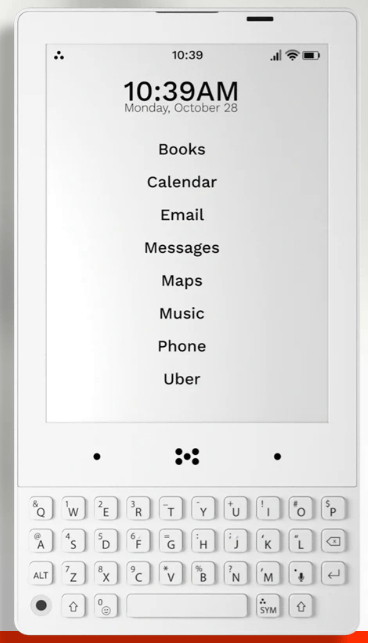
That is an e-ink screen (like in a Kindle or other e-reader), and a physical QWERTY keyboard. It has basically everything else you expect from a smartphone in 2025 (bluetooth, NFC, wireless charging) and a couple things you don’t (a headphone jack), but the biggest difference is the screen.
The goal of the screen is to help you use your phone less — to make it less enticing. It’s good enough for reading emails, or ebooks, or texts. But it’s terrible for watching youtube on.
Like basically everyone, I’m worried about the amount of time I waste with my phone. So I bought one, and I’ve been trying it out for not quite a week. Here are my thoughts.
It does what it sets out to do
This phone makes a lot of normal phone stuff irritating to do, so you don’t do it. That’s great! That’s the goal.
What I found is that I replaced my youtube or web browsing time with reading an ebook. I didn’t realize how much I was spending my time doing that until I started, and then finished, Keigo Higashino’s “A Midsummer’s Equation” in less than three days. Apparently if I had this phone and replaced my youtube time with reading time I would read approximately 120 books a year. So I’m feeling great about that.
It also does regular phone stuff passably. It has a color camera, so even though the e-ink screen can’t show colors, the pictures I take do indeed have color. It’s not an amazing camera, but it’s good enough to get the job done.
(although I will forever question the placement of the selfy camera. If you look on that picture above you can see it, right below the ALT button on the keyboard. Why???)
I like that I can plug it into my car and it does android auto just like any other phone, although the phone itself is a little gutless (it uses a MediaTek budget-focused processor) so it was constantly telling me that it had to disable features, or I should turn the screen off, or that the phone was overheating. It still got me home and played the new Sleep Token album on the way, though, which is all I ask of it.
So it’s great at a couple things, passable at most, and terrible at the things I want to avoid. That’s a win overall!
(also, I should point out that the keyboard is fine — I was never crazy about physical keyboards, but I’ve gotten used to it. If you miss your blackberry, number one, you’re so old, and number two, you’ll probably like this phone)
The downside
This is a new phone from a new company. It was crowdfunded. Honestly …. it’s pretty amazing that it works as well as it does!
But there are still rough edges. The OS isn’t designed for a black and white screen with a super low refresh rate, so getting around and doing anything is a pain. It’s also obvious that the company couldn’t devote a bunch of time to modifying android itself, so some stuff that should definitely be different isn’t.
For example!
With an e-ink screen, paginated interfaces work better than smoothly scrolling ones. The notification shade is a smoothly scrolling interface element — you pull it down and it follows your finger, you swipe through notifications, and you swipe down to expand the shortcut buttons. You also swipe notifications aside to dismiss them, or swipe them a little to expand them.
All of that feels AWFUL on an e-ink screen. It looks bad, scrolling through stuff doesn’t follow your finger, and you don’t know if you’ve swiped enough to expand it until a second or two after you try.
A paginated interface relying more on buttons than swipes would’ve worked wonderfully here. Swipe from the top (or hit a button) and the shade appears all at once. Swipe through pages of notifications. Tap a button to dismiss or expand notifications. Tap another button to expand the shortcut buttons up top. It would’ve felt so much nicer.
Android is full of things like that — little design flourishes that are supposed to make you go “OOoooh, how cool!” with your fancy new phone with an OLED screen and a 120 hz refresh rate. When your less-fancy new phone has an e-ink screen these same flourishes diminish the experience.
This is, of course, the result of having a smaller team. To make the phone usable for more people they needed android apps. For android apps to work they needed android. They made a decision — the rough edges of the interfaces were outweighed by the need for the phone to be useful enough to people to use it as their main device.
When looking at how to make the version of android more usable they also had limited dev time and had to make decisions about what to modify (they made a custom homescreen, for example) and what to leave (the aforementioned notification shade).
I think they made pretty good choices, overall, but compromises had to be made. It is what it is.
The other downside
The other problem is that the phone has some bugs. Again, small team, new hardware, etc. Some apps simply will not work for me. Some apps that previously interacted now don’t work together correctly. The fingerprint reader forgets one of my fingers every time I restart, for some reason.
This is the other downside of any new hardware, and believe me, I’m used to it. I had a pebble smartwatch. I had a CR-48 chromebook! Bugs are normal, but on a device as vital to most people’s daily life as a phone, it is REALLY hard to let them slide.
Most of these bugs will be resolved over time (again, pebble watch, chromebooks), but it takes a while.
That’s why I’ll probably do what many people do — set the phone aside for 3-6 months, and see if the bugs have been sanded down enough for me to use it as a daily driver in the future. I think this phone definitely could be a daily driver for many people — though maybe not as many people as the enthusiastic response would lead you to believe … let’s finish by talking about that.
The Total Addressable Market Problem
Anyone putting together a business, or a product, or an app will, at some point, try to calculate a “total addressable market” — that is, the total number of people who might use a specific thing.
Often, especially with technology companies, these numbers are basically insane. Do you remember Juicero? It was a $700 juicing machine that squeezed subscription based packets of pre-cut fruit to make one glass of juice (the bags were $5-8 each). Juicero wanted to bring fresh-squeezed juice to every home in America.
So in their pitch decks they probably said “Our total addressable market is 140 million American homes! (until we expand globally).” That’s a lot of juicers! Then they thought about all that recurring revenue from juice bags (I mean, every home has at least two people, they’ll want at least … let’s be conservative and say 2 fresh squeezed juices a day, at a cost of let’s say just $4 per bag, that means 2 people, times twice a day, times four bucks a bag, times one hundred and forty million homes, times 365 days a year …. that’s $817,600,000,000 a year just from selling juice bags!) and little cartoon dollar signs appeared in their eyeballs.
Now you, and I, and everyone …we all recognize that’s crazy. But what’s gets people is the next step. They go “Listen, we know $817 billion a year in juice is unreasonable, but what if we just get …. 1% of the Total Addressable Market? That seems reasonable, right? If we ONLY get 1% of the market (and we’ll definitely get that, right? it’s just one percent!) we’ll still be making a billion dollars a year in juice pouches! We can’t fail!”
Spoiler alert, they failed.
See, when you make total addressable market you should be as aggressive as possible about cutting it down. It should be as pessimistic as possible, so that it’s as realistic as possible. Imagine if Juicero had looked at their total addressable market like this:
- Total number of US households (140MM)
- Number of juicers that sell every year in the us — about 1.5MM (uh oh, now our addressable market is starting to shrink a lot to maybe 1.5MM, assuming we get 100% of the juicer sales next year)
- % of juicers sold that cost over $500 — 10% (now we’re down to just a TAM of just 150,000)
In the end, we don’t know how many Juiceros sold, but I am going to bet it wasn’t 150,000. The problem is that Juicero was a niche product. You had to REALLY care about juice and REALLY buy into this specific lifestyle and REALLY have some extra cash to get one.
That that means is that, regardless of what their claimed TAM was, they probably saturated their ACTUAL TAM with the first shipments.
Any niche product is like that. And the minimal phone is a niche product. It’s not going to achieve widespread success because, if we look at our TAM funnel, it would look like this:
- Number of android users
- Who think they spend too much time their phone
- AND are willing to spend several hundred dollars to fix it
- AND are willing to not see how their pictures turn out when they take them
- AND are tech savvy enough to work around inevitable bugs/rough edges
- AND …
You get the idea. Minimal may have already saturated their own TAM. In fact, with the tradeoffs with the phone as people start using it the TAM might shrink a little more.
I worry about that because I do like the product and, I think with some polish, it could work really well for my needs. But I’m not sure if it will stick around long enough to get there. I guess that’s the risk of all crowdfunded products.
And here’s the catch 22. If it were me, I would wait a few months to pick up a minimal phone. I think it’ll eventually be a good option for a lot of people.
But by saying that, what if I turn away people that Minimal needs to continue operating? So I guess for my own selfish purposes, go buy a minimal phone! And then we’ll keep checking in every few months to see if it gets there.
An Update, 3 months later …
Well, it’s three months later, and for some reason bunch of people looked at this blog post today, so I figured I’d update it with the latest.
And the latest is … Minimal Phone people have not shipped any software updates. So it still sits on my counter, waiting for the day when it’ll be usable enough to become my daily driver.
I’m also in the Minimal Phone discord and people are PISSED. There’s two main issues:
- People bought screen protectors and cases (I bought a case) and they still haven’t shipped, but the phones have, and while waiting for their cases and/or screen protectors some people have used and then broken their phones. That’s understandably frustrating.
- The aforementioned lack of software updates. This is compounded by some pretty unfortunate communication:
- June 13th — They promised a “major update” being sent in for approval in the “next couple of days” with fixes for some major complaints.
- July 1st — They said the fingerprint issue was included in the major update and that it was submitted “yesterday and will take 2-4 days for approval. We should have the OTA by Friday or Monday if approved”
- July 7th — They said it was delayed by 2 weeks due to regressions.
- August 5th — The major update was replaced with a “small software update with minor bug fixes …” that was to be shipping in “about 2 weeks” with the major update following in 4 week.
That was the last communication, which was two weeks ago today, so the smaller update should be dropping any day now, although even if that DOES happen it’s still disappointing given the expectation was initially set for a major update over two months ago.
That’s, unfortunately, how a lot of software development goes. I’ve run a few development projects, and it’s crazy how you can look at a backlog and go “Oh yeah, we’ll knock this out no problem!” and then you finish a sprint and go “Well, this story wound up being WAY more complicated than we thought so … we shipped two new features.”
Over time you get better at estimating the amount of effort for a given feature and eventually you can make promises and keep them. The minimal phone folks don’t seem to have reached that level of software development yet, and they’ve got a catch 22. Be transparent and potentially miss deadlines or “under promise and over deliver” and just … make people made for three months while you work on software in radio silence.
I mean, there is a third path. Frequent development updates without making promises for when it’ll be ready. This is transparent, but REALLY hard to do because it’s so tempting to just say “Oh yeah, we’re almost done!” and not realize that the last 10% of a project takes 50% of the time.
I can’t fault the minimal phone people for having a hard time with this, and I can’t fault the people who crowdfunded it for being upset about it. I am going to update my recommendation so it’s not quite so selfish, though, and say wait for them to ship at least two updates before plunking any money down. I’ll check back in here in another three months to let you know if that major update was actually delivered, and if I’m using it as my daily driver.
 Josh Boyles