Let’s tackle our two theses in reverse order:
Please stop social medizing
When I say “Social Media” I’m referring to general social media. Facebook, Twitter, Instagram, TikTok, MySpace, even Reddit at times.
Social Media with a specific purpose seems less harmful to me. So I use LinkedIn for work, and there are some modern chat rooms and/or forums that I connect to about things like cybersecurity or whatever.
But general social media, where anyone can (and does) talk about anything, is terrible.
I’m not going to go into why it’s terrible. You know it is! Everyone knows it is! And yet we still do it.
Instead I want you to take a second and do an activity with me:
- Get a piece of paper and pencil (or open a text editor on your computer)
- Write down how you typically feel after getting lost in social media feeds for an extended period of time
- Write down some other activities that, to you, feel more fulfilling
- Write down any actions that you have taken due to something on social media that were NOT one of the following:
- Doing something else on social media
- Purchasing something
- Giving money of some kind
- Something that you could’ve easily done through a regular search engine (like how to replace a sparkplug or how to cook rice)
My guess is that your answers look something like this:
I feel crappy or (best case scenario) slightly amused after social media. I feel more fulfilled if I spend time with family, read a good book, play an instrument, go for a hike, etc. etc. etc. And that one time I got that recipe from tiktok — Oh, I guess I could’ve googled it. Nevermind. Nothing
If your answers look anything like that, just stop! Close your account! Delete your apps! Whatever!
And start a blog!
In Walden, Thoreau said:
We are in great haste to construct a magnetic telegraph from Maine to Texas; but Maine and Texas, it may be, have nothing important to communicate … we are eager to tunnel under the Atlantic and bring the old world some weeks nearer to the new; but perchance the first news that will leak through into the broad flapping American ear will be that Princess Adelaide has the whooping cough.
Postman expanded on that in Amusing Ourselves to Death, saying:
Thoreau … grasped that the telegraph would create its own definition of discourse; that it would not only permit but insist upon a conversation between Maine and Texas …
… telegraphy gave a form of legitimacy to the idea of context-free information; that is, to the idea that the value of information need not be tied to any function it might serve in social and political decision-making and action, but may attach merely to its novelty, interest, and curiosity. The telegraph made information into a commodity, a ‘thing’ that could be bought and sold irrespective of its uses or meaning.
The telegraph reduced friction from the act of sharing information. This reduction of friction has continued until it reached its peak — messages that could be sent anywhere, at any time, for any reason, as long as they were short (140 characters or less!).
But reducing the friction reduces the value. Imagine Thoreau’s expression if he was sent an instagram post with a picture of someone’s dinner.
So add some friction back into your sharing deliberately — start a blog!
It’s not that much friction, but having a “post” with a “headline” and a “thesis” of some kind forces you to order your thoughts. You take time to write, improving your writing ability (hopefully). You do some research and maybe you even refine those thoughts — they grow beyond what they would’ve been if you’d just dashed off a tweet and called it a day.
And best of all, very few people will read them!
Maybe that seems like a bad thing, but let’s look at what you get from social media:
- Lots of shallow connections
- Indicators from those shallow connections let you know which posts “gain traction,” which subtly steers you away from something unique and special and towards something with broad appeal
- FOMO, envy, etc. as you are fed the carefully cultivated facade of these shallow connections
What do you get from a blog?
- You improve your communication, research, critical thinking, etc. just by the act of writing
- A few deep connections may read your blog, but not a lot. People will generally only read them if they actually care about you, or if they actually find your work insightful
The benefits don’t come from others, they come from the act itself. Just to set your expectations, let’s look at my weekly traffic for this very blog since I’ve started it:
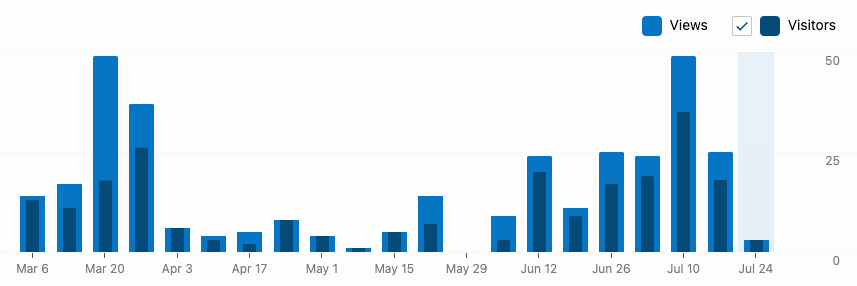
On my most popular week (a week I posted TWO WHOLE TIMES) I had 35 visitors, and 49 total views. Most weeks I get less than 10.
That’s fantastic, because I’m writing blogs either for a few people I actually care about, or solely for myself, because I find joy in it. I’m not doing it for broad appeal. Because of that, it’s something I enjoy.
So, if you want to share your thoughts online, make yourself a blog and do it right. And by that I mean:
- Do it to become a better communicator, researcher, etc
- Do it knowing few people will read it, but it will matter to those that do
- Don’t do it to please a bunch of strangers
So shut down your facebook, twitter, instagram and tiktok and send me a link to your blog and I promise I will read at least the first … five posts. That seems fair, right?
 Josh Boyles