I studied sociology in college, and one book that came up in those introductory classes was Erving Goffman’s “The Presentation of Self in Everyday Life.” I hunted down my copy and took a picture:
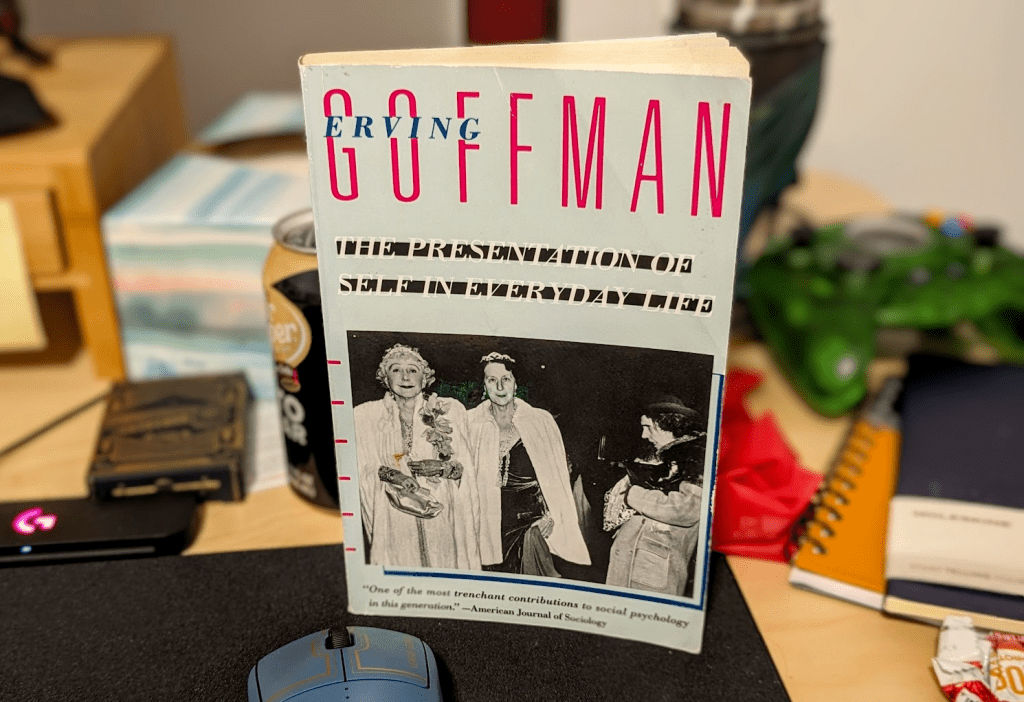
This book was written just shy of eighty years ago, and it builds off other works and ideas from decades and centuries before then, and yet it still feels applicable today — maybe even more applicable than when it was published.
Goffman points out that the way we present ourselves to others is designed to create an impression of who we are. The language we use, the clothes we wear, the way we stand, the places we go … all of these choices are made with an eye towards influencing how other people see us.
In the era of social media the idea that people put up a facade is almost quaint. We expect it now, and we may even account for it. But the people posting know we expect it, and know we account for it, so in their posts they may present a multi-layered facade — they create a surface layer, then peel back the curtain themselves to display the “real thing” — a second layer that has also been engineered to generate an impression.
Or, as John Mulaney put it in his recent special “Baby J“
“And, as you process and digest how obnoxious, wasteful, and unlikable that story is, just remember — that’s one I’m willing to tell you.”
Look again at my picture up there, of my worn college book sitting on my desk. I’ve got an empty doctor pepper can behind it. Some notebooks. Garbage. An elastic band from physical therapy. An xbox controller. All of it blurred because the main point of the picture was the book, but all of it still visible. Maybe it’s transmitting a message that my desk wasn’t staged — that it’s messy, and thus you can trust that I’m being sincere and transparent. Or maybe I intentionally staged my desk that way. Maybe it was messy, but with more embarrassing stuff and I rearranged the stuff on my desk so the only stuff visible was slightly embarrassing, so that I would appear self deprecating, but not genuinely embarrassing.
(in truth, I brought the book in my office and set it on my desk and only moved one item into the frame, the empty Dr Pepper Can, and didn’t move anything else from where it was. OR DID I???)
The real thing that stuck with me after reading the book was that much of the self we present is socialized — much of what we do isn’t conscious, it’s molded by others’ expectations, along with our own desires. We are also the audience for the self we are presenting — we want to convince ourselves that we are who we say we are as much as we want to convince others.
That is why I kind of hate talking about myself. I’ll share stories now and then, but every time I do I’m hyper aware of the impression the story is setting. I tweak it to make it less grandiose, then tweak it again to make it less self-deprecating. Usually I try to tell a story about someone else when illustrating a point so that I don’t have to say anything about myself. But maybe all that comes off as false humility. I mean, maybe it really IS false humility. Maybe I want to convince myself I’m humble, so I cringe at my own stories and tell someone else’s.
See how hard this is? Now just imagine my endlessly spiraling thought process as I write this exact blog post.
The antidote to endlessly questioning ourselves and our own motivations is to be what Carl Rogers called “congruent:”
The term “congruent” is one I have used to describe the way I would like to be. By this IU mean that whatever feeling or attitude I am experiencing would be matched by my awareness of that attitude. When this is true, then I am a unified or integrated person in that moment, and hence I can be whatever I deeply am.
Carl Rogers, On Becoming a Person
Rogers goes on to state that the act of being completely what you are is incredibly difficult — it is a process that takes a lifetime of effort. At least.
So I’d like to share more of myself, but as I think about that I’m a little worried because when it comes down to it … well, I’m not a boring person, but I don’t think my autobiography would fly off the shelves.
(speaking of which, I’ve often thought of writing an autobiography and titling it something like “A story of a normal life” — all autobiographies are written by people who are in some way exceptional (even if it’s exceptionally delusional) and I think it would be interesting for other normal, boring people to read an autobiography about a normal, boring person to know that hey, not everyone is some kind of dynamo. But then I’m like … who would like to read about someone who isn’t a dynamo?)
But I’ll try to be congruent — to be the person I am, and to be willing to share that. I’ll try to avoid overthinking my blog posts and instead post stuff that is just … useful. Interesting. Or, occasionally, stuff that is just on my mind. Like this.
 Josh Boyles