The following is the impression I’ve got from studying leadership development and personal change. I’m posting this to get my thoughts down so I can get feedback on the philosophical underpinnings of a potential leadership development solution — so let me know your thoughts!
Who can be a manager?
A challenge for every business is figuring out who to make a manager or leader. Businesses often just promoting their best individual contributor, making the crucial mistake of “turning your best engineer (or whatever) into your worst manager.”
The main reason businesses make this mistake is that they are using outdated methods of selecting leaders. There is a belief that some people have “the right stuff” and some people don’t. Some people “get stuff done” and others need to be micromanaged. However you say it, what it boils down to is most people don’t know how to choose effective managers, so they just … guess.
In “High Flyers,” McCall completely destroys this idea and practice. The whole point of the book is that leaders can be grown, but it takes deliberate development. It takes a plan. McCall says you need to identify people with potential — people who have certain personality traits that, among other things, helps them learn from mistakes.
(sidenote — it’s interesting that McCall’s chapter on this basically says “Not everyone can be a leader — someone who doesn’t learn from their mistakes is incapable of leadership. So here’s how you identify people with the capacity to learn”)
Once potential leaders are selected they need to be given growth promoting experiences and mentoring (more on this in a different blog post — it’s probably not what you’re picturing).
So the answer to “who can be a manager” is “people with certain traits who are put in the right situation.”
Can you learn these traits?
If the existence of traits is a prerequisite for leadership, could someone who wants to be a leader develop these traits? It’s here that I’m going to borrow a concept from Seligman’s “What you can change…and what you can’t*” (man, that is an awkward title. The * is IN THE TITLE, and references a line at the bottom of the title page: “*learning to accept who you are”) (also, there’s a subtitle I’m not even bothering with!).
Seligman points out that some parts of people are more deep-seated — more intrinsic to who they are, while others are more surface level. Surface level things can change, while as intrinsic personality is significantly more difficult to change. If we were to modify this for the workplace we might make a continuum that looks like this:
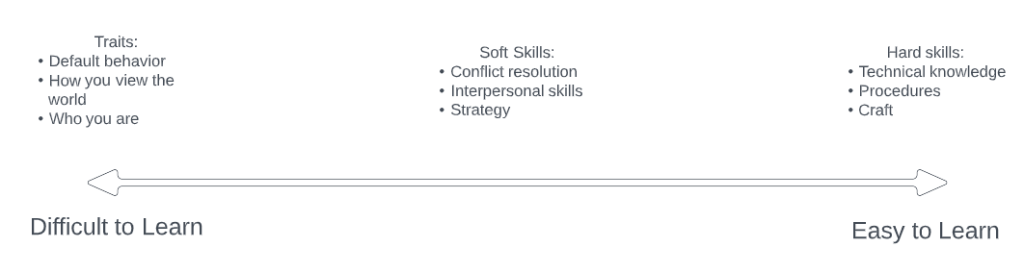
You can learn almost anything, but some things are much harder to learn and change. It is very difficult to teach someone to BE DIFFERENT. To be something other than the person they already are. It’s not impossible — but it’s extremely difficult.
Hard skills such as technical knowledge, on the other hand, is comparatively very easy to teach. You can teach someone how a network works, or how a CNC machine functions, or how to raise beans. We’re very good at teaching these things, so most formal teaching like college focuses on this side of things.
In the middle are soft skills — skills that are difficult to teach in college. Soft skills are taught almost entirely through experience — and it’s not a guarantee that the person will learn the right lessons from the experience.
So who can become a leader?
Most people can become leaders in some form, the only question is how much effort will it take to get them there? If you’re trying to develop leaders internally McCall has it absolutely right — you need to find people who have the most potential to be leaders. Not “potential” as in “my gut tells me this person has potential” but potential as in “They exhibit indicators that they have some degree of McCall’s ‘Eleven Dimensions of early identification of global executives.’” In other words — a formal method of determining potential.
Another thing that matters is organizational and personal alignment. Certain types of leaders tend to do better in certain organizations. It’s helpful if you can figure out which traits make someone successful in your org, then use those as criteria for finding individuals in your workforce who would lead well in your org.
Is this true?
In your experience, is the graphic above accurate? That is the very first step in creating a leadership development program — understanding what needs to be developed, what can be developed, and what can’t. And I think that very simple graphic gets at the crux of it. It also seems to indicate how you should focus your efforts:

 Josh Boyles